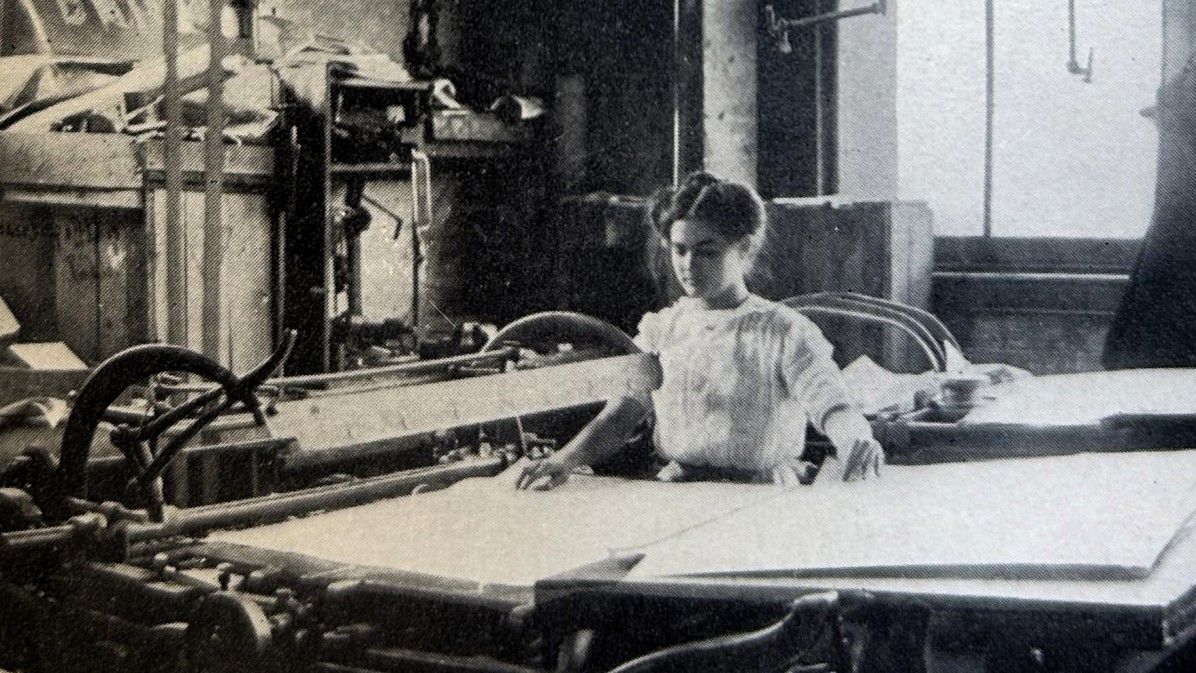
Bookbinding was a place that saw one of the earliest women’s labor organizations based in manufacturing. With jobs traditionally associated with sewing, women made up half of workers engaged in the industry, and the International ‘Brotherhood’ of Bookbinders could not ignore them, with all-female locals of the Bindery Women’s Union. However the nature of he craft union outlook meant that the I.B.B. was utterly incapable of equalizing wages or meeting the challenge of technological changes happening in the industry.
‘One Big Union as Illustrated by the Bookbinding Industry’ by Jean E. Speilman from Solidarity. Vol. 2 No. 49. November 25, 1911.
One glance at the bookbinding industry will convince any casual observer that the same has undergone some radical changes. One need only walk in any edition bindery and one could not fail to that hardly a year goes by but some new machine is introduced which displaces both men and skill, thus increasing the ranks of the unemployed and also reducing skill to a minimum.
With the advent of the case making machine, the rounder and backer and casing in machine, hundreds, aye, thousands of men have been thrown out of employment. Upon a little investigation one will readily see that, aside from the fact that books are produced today in larger quantities, with the aid of machines, that it takes less skill to produce them, that the skillful mechanic is rapidly becoming a thing of the past.
In former times a bookbinder was supposed to know the making of a book from the sewing bench to the finishing table, while at present the bookbinder is simply reduced to the function of an operator of a case making machine. Very few bookbinders are completing a book from A to Z nowadays. They either are casemakers or headband liners, etc.
One may think that the blank book branch has not suffered any changes. The blank book branch has also undergone some considerable changes. Aside from the division of labor which is taking place, the loose leaf system is rapidly displacing the blank book. It’s nothing out of the ordinary to find metal workers and machinists employed side by side with bookbinders. Of course the writer will admit that in some small shops the same method is pursued in the making of a book, that the same tools are in use which were in use 25 years ago.
But we are dealing with the changes that have taken place in the bookbinding industry as a whole. Out of about 28,000 bookbinders employed in the bookbinding industry, only about 7,000 belong to organized labor. One would conclude that the three-fourths unorganized are not class conscious enough to join their fellow workers’ union; but such is not the case. If given an opportunity they may take advantage of same, but we as an organized body would not accept them, though we boast of trying to get 100 per cent organization. We keep them out. The old contention is still in vogue (not skillful), regardless of the fact that machinery, and the loose leaf system are practically eliminating skill. Yet we shut our eyes and keep out the unskilled (?) mechanic.
The veracity of these statements could be proven by any constitution and by-laws of any local union of the International Brotherhood of Bookbinders. Of course, the employers join the chorus, declaring “that nothing but skilled labor will do.”
The above stands good only in times of peace. Should a strike take place, then the employer has a few skilled mechanics and fills up the balance with unskilled help, and thus succeeds in breaking the strike, while the skilled mechanics on strike are rejoicing over the fact that the employer is unable to secure competent help.
The writer witnessed a case where 40 members of a local union (skilled mechanics) went out on strike. Their places were immediately filled by unskilled mechanics, with the aid of four skilled bookbinders (That was a loose leaf shop exclusively.) Needless to say that this strike was lost. That defeat could have been turned to victory had the machinists and metal workers employed therein joined the bookbinders in their fight. The bookbinders were defeated and the other crafts were served notice that they will meet a like fate should they attempt to strike for better conditions.
The bookbinders were alone in that fight, while the employers had the backing of the entire Manufacturing Association, who were using every weapon conceivable to defeat the bookbinders. They were not rendered asunder by jurisdictional squabbles, and they had one aim in view, to keep the bookbinders in subjection. Unlike the bookbinders, the master bookbinders have one organization which controls all the branches comprising the making of a book. The member of the above organization, no matter what he is manufacturing, be it blank book or loose leaf devices, etc., belongs to one and the same organization; in other words, it’s an industrial organization.
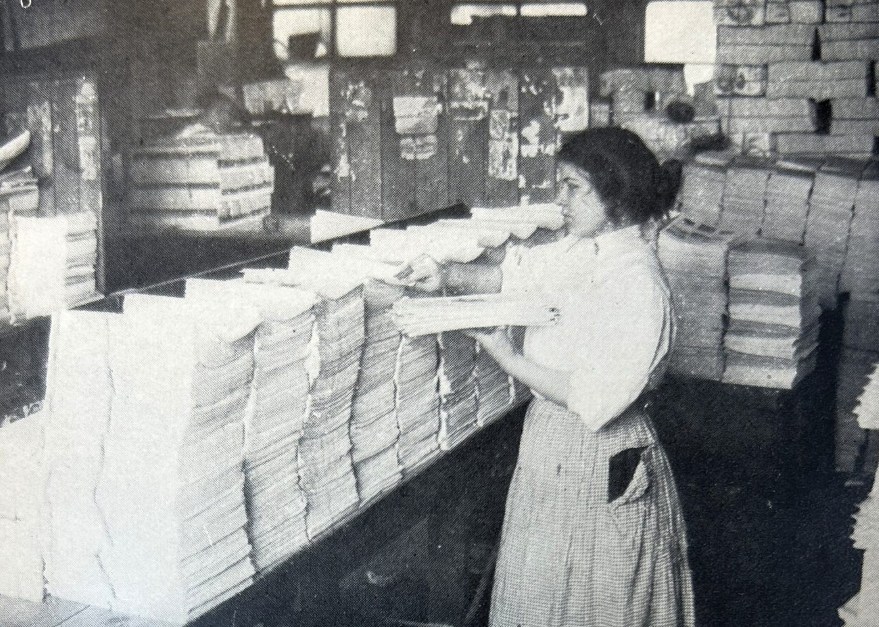
When the Bookbinders’ Union is fighting an employer it is fighting the Employers’ Association (the Typothete). All the forces of this organization are marshaled against it, while it is a common occurrence to see one local striking while another local is staying at work (technically scabbing).
To cite the case of L.U. No. 2 of Philadelphia, Pa., working, while L.U. No. 161 was striking. (L.U. No. 161 vs. Henry Bartel Co., Jan. 10, 1911) Or, to cite the New York case, L.U. No. 43 on strike against the Trow Publishing Co., while Locals Nos. 1, 11 and 22 stayed at work: (Jan. 25, 1911).
Furthermore, it is nothing unusual to see bookbinders at work, while printers and pressmen are on strike, or vice versa, Of course, the bookbinders may think they are justified in working while some other branch is on strike, by virtue of the fact that they have a contract with the employers, and the printers may feel justified in staying at work for the same reason as enumerated above, but it couldn’t be denied that the contract of one local or of one craft is used as a club against the other local or craft. We may be imbued with the idea that the printers’ fight is not ours, and they may think likewise, but that does not alter the situation. One thing is an established fact, that an employer first gets rid of one craft union until he succeeds in getting rid of all one by one and is running a non-union shop. One could easily deduct from the above that “an injury to one is an injury to all.” Aside from a technical inexpediency let’s view it from an economic standpoint. We have in New York City seven locals affiliated with the I.B. of B., each having its officers and offices and business agent. Let us consider the expenses involved to keep up seven separate locals, with their separate meeting halls, separate offices and the salaries for their business agents. Supposing we had only one solid local instead of seven. The result would be that, first of all, the jurisdictional feuds would be eliminated and, second, we could keep two energetic, well paid organizers in the field to organize the unorganized and the unskilled (?) employed in the sample card and photo album shops. To conclude, we must admit that we are not abreast with the times. The very fact that out of 28,000 bookbinders employed at the trade we only have about 7,000 (one-fourth), should encourage us to look for other methods in organizing, and the method is at hand and is within our reach. The employers themselves are furnishing us with that method. They are setting an example by putting up a solid front, by virtue of the fact of being united in one big union. They are organized industrially. Every time, when defeated by them, it is but another challenge to organize in one big union.
JEAN E. SPIELMAN, International Bookbinder.
The most widely read of I.W.W. newspapers, Solidarity was published by the Industrial Workers of the World from 1909 until 1917. First produced in New Castle, Pennsylvania, and born during the McKees Rocks strike, Solidarity later moved to Cleveland, Ohio until 1917 then spent its last months in Chicago. With a circulation of around 12,000 and a readership many times that, Solidarity was instrumental in defining the Wobbly world-view at the height of their influence in the working class. It was edited over its life by A.M. Stirton, H.A. Goff, Ben H. Williams, Ralph Chaplin who also provided much of the paper’s color, and others. Like nearly all the left press it fell victim to federal repression in 1917.
PDF of full issue: https://www.marxists.org/history/usa/pubs/solidarity-iww/1911/v02n49-w101-nov-25-1911-Solidarity.pdf

