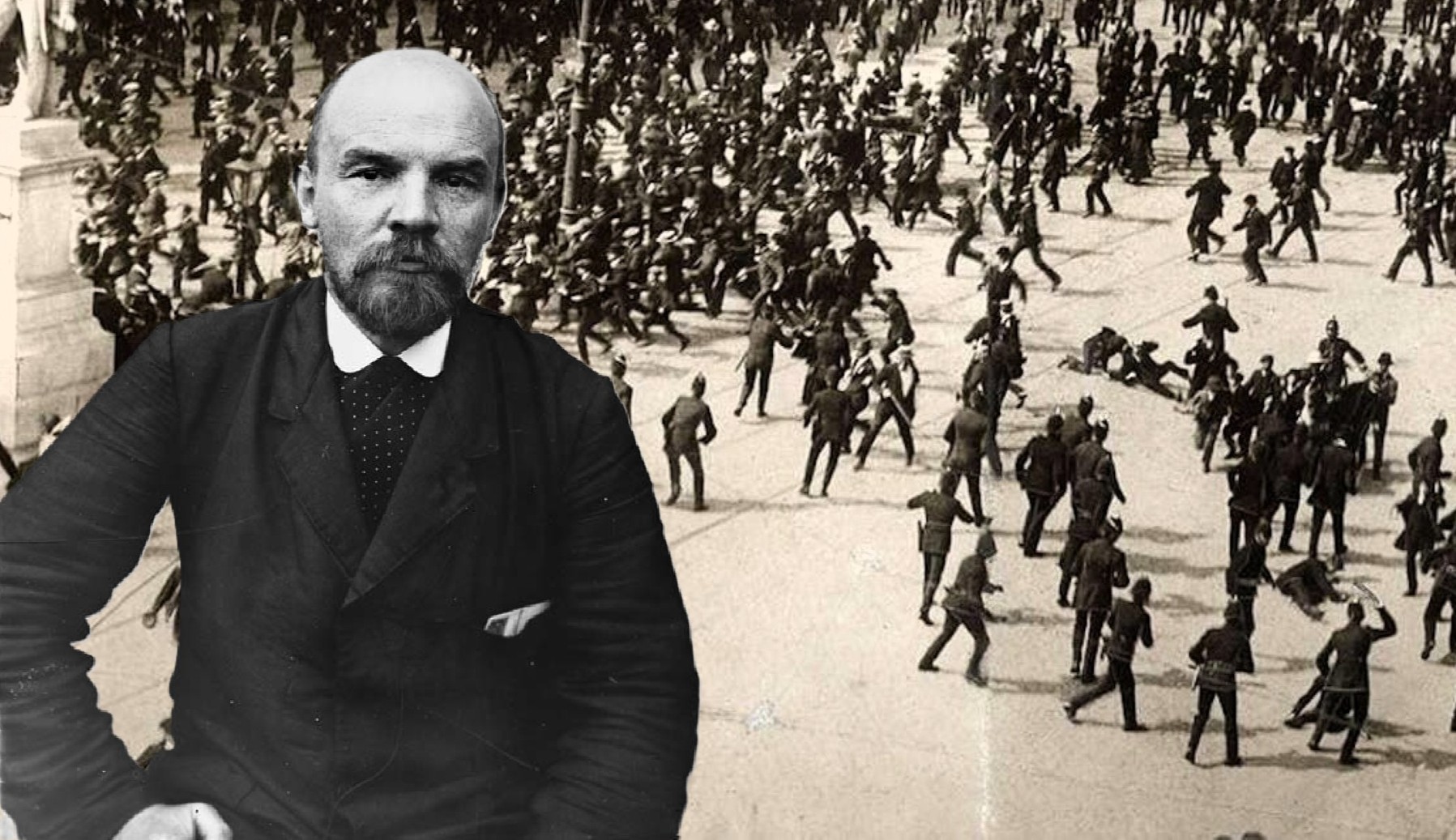
Lenin on the 1913 Lockout in Dublin led by James Larkin, James Connolly and the Irish Transport and General Workers Union. First published in Severnaya Pravda No. 23, August 29, 1913 (old).
‘Class War in Dublin’ (1913) by V.I. Lenin from Lenin on Britain. Marxist Library No. 31. International Publishers, New York 1934.
IN Dublin, the capital of Ireland, a city with half a million population, not very much of an industrial type, the class struggle, which has permeated the whole life of all capitalist society, has become intensified to the degree of class war. The conduct of the police is positively atrocious; drunken policemen assault peaceful workers, break into houses, torment the aged, and women and children. Hundreds of workers have been injured (over 400) and two have been killed–such are the casualties of this war. All the prominent labour leaders have been arrested. People are thrown into prison for uttering the most peaceful speeches. The city is like a military camp.
What is the matter? How could such a war flare up in a peaceful, cultured, civilised free state?
Ireland is something of a British Poland, only rather more of the Galician type than the Warsaw-Lodz-Dombrovsky. National oppression and Catholic reaction have transformed the proletarians of this unhappy country into paupers and the peasants into toil-worn, ignorant and dull slaves of priestcraft; they have transformed the bourgeoisie into phalanxes of the capitalists and despots over the workers masked by nationalist phrases and, finally, they have transformed the administrators into a gang accustomed to every kind of violence.
At the present moment the Irish nationalists (i.e., the Irish bourgeoisie) are the victors: they are buying out their land from the English landlords; they are receiving national home rule (the notorious home rule for which the long and stubborn struggle has been waged between Ireland and England); they will freely govern “their” land in conjunction with “their” Irish priests.
And this nationalist, Irish bourgeoisie is celebrating its “national” victory, its “State” maturity by declaring a war of life and death against the Irish labour movement.
In Dublin there lives the English Viceroy. But in actual fact his power yields to the power of the leader of the Dublin capitalists, a certain Murphy, the publisher of the Irish Independent (sic!), the principal shareholder and director of the Dublin tramways, and shareholder in a large number of capitalist enterprises in Dublin. Murphy has declared, in the name of all the Irish capitalists, of course, that he is ready to spend three-quarters of a million pounds to destroy the Irish trade unions.
And these unions were beginning to develop splendidly. In the wake of the Irish bourgeois scoundrels who are celebrating their “national victory there followed the Irish proletariat that is awakening to class consciousness. It has found a talented leader in the person of Comrade Larkin, the secretary of the Irish Transport Workers’ Union. Possessing remarkable oratorical talent, a man of seething Irish energy, Larkin has performed miracles among the unskilled workers–that mass of the British proletariat which in England is so often cut off from the advanced workers by that cursed petty bourgeois, liberal, aristocratic spirit of the British skilled worker.
A new spirit has been awakened among the Irish labour unions. The unskilled workers have introduced hitherto unparalleled animation in the trade unions. Even the women have begun to organize–a thing hitherto unknown in Catholic Ireland. Dublin showed promise of becoming one of the foremost towns in the whole of Great Britain as far as the organisation of the workers is concerned. The country, the characteristic figure of which was the fat, well-fed Catholic priest and the poor, hungry, ragged worker who wears rags even on Sunday because he has not the wherewithal to purchase Sunday clothes–this country, bearing a double and triple national yoke, was beginning to be transformed into a land of the organised army of the proletariat.
Murphy has proclaimed a bourgeois crusade against Larkin and “Larkinism.” For a beginning he discharges two hundred tramwaymen during the Exhibition in order to start a strike and to embitter the whole struggle. The Transport Workers’ Union declares a strike and demands the re-instatement of the discharged men. Murphy organises a lockout against the workers. The latter retaliate by going on strike. War is raging all along the line. Passions are rising.
Larkin who, incidentally, is a grandson of the famous Larkin who was executed in 1867 for participating in the Irish emancipation movement–Larkin delivers passionate speeches at meetings. In these speeches he points out that the party of the English bourgeois enemies of Irish Home Rule is openly calling for resistance to the government, is threatening revolution, is organising armed resistance to Home Rule and is flooding the country with revolutionary manifestoes with impunity.
But what is permitted to the reactionary English chauvinists, Carson, Londonderry and Bonar Law (the English Purishkeviches who are oppressing Ireland)–is not permitted to the proletarian Socialist. Larkin is arrested. Workers’ meetings are prohibited.
But Ireland is not Russia. The attempt to suppress the right of assembly gives rise to a storm of indignation. Larkin had to be tried. And at the trial Larkin became the accuser and actually puts Murphy in the dock. By cross-questioning witnesses Larkin proves that Murphy had had long conversations with the Viceroy on the eve of his, Larkin’s arrest. Larkin declares that the police are in the pay of Murphy, and no one dares refute Larkin.
Larkin is let out on bail (political liberty cannot be abolished at one stroke). Larkin declares that he will be at the meeting no matter what happens. And indeed, he comes to the meeting disguised, and begins to speak to the crowd. The police recognise him, seize him and assault him. For two days the dictatorship of the police truncheon rages, crowds are beaten up, women and children are tormented. The police break into workers’ houses. A worker named Nolan, a member of the Transport Workers’ Union is beaten to death. Another dies from injuries.
On Thursday, September 4, Nolan’s funeral took place. The proletariat of Dublin organised a procession 50,000 strong and accompanied the remains of their comrade to the grave. The brutal police hid themselves, not daring to irritate the crowd, and exemplary order prevailed. “This is a more magnificent demonstration than the one that took place at Parnell’s funeral” (a celebrated leader of the Irish nationalists), said an old Irishman to a German correspondent.
The Dublin events mark a turning point in the history of the labour movement and of socialism in Ireland. Murphy threatened to destroy the Irish labour unions. He only succeeded in destroying the last remnants of the influence of the nationalist Irish bourgeoisie over the proletariat in Ireland. He has helped to harden an independent, revolutionary labour movement in Ireland, free from nationalist prejudices.
This was seen immediately at the Trade Union Congress which opened on September 1, in Manchester. The Dublin events had roused the delegates–in spite of the resistance of the opportunist trade unionists with their petty bourgeois spirit and their admiration for the bosses. The delegation of the Dublin workers was given an ovation. The delegate Partridge, the chairman of the Dublin branch of the Engineers’ Union related the acts of violence and outrage committed by the police in Dublin. A young woman worker had just gone to bed when the police broke into her house. The girl hid in the closet. She was dragged out of there by the hair. The police were drunk. These “men” (in quotation marks) beat up ten-year old boys and five-year old children.
Partridge was twice arrested for making speeches which the judge himself admitted were peaceful. I am sure, said Partridge, that I will now be arrested if I publicly recite the Lord’s Prayer.
The Manchester Trade Union Congress sent a delegation to Dublin. The Dublin bourgeoisie again took up the nationalist weapon (exactly like the bourgeois nationalists in Poland, or in the Ukraine, or among the Jews!) and declared: “Englishmen have no business on Irish soil.” But the nationalists, fortunately, have already lost their influence over their workers.
At the Trade Union Congress in Manchester speeches were delivered of a kind that have not been heard for a long time. A resolution was moved to transfer the whole Congress to Dublin, and to organise a general strike throughout the whole of Great Britain. Smilie, the chairman of the Miners’ Union, declared that the Dublin methods will compel all the workers to agree to revolution and that they will learn to use arms.
The masses of the English workers are slowly but surely taking a new path from the defence of the petty privileges of the labour aristocracy to the great heroic struggle of the masses themselves for a new system of society. And, bearing in mind the energy and state of organisation of the English proletariat, they will bring about socialism on this path much more quickly and firmly than anywhere else.
International Publishers was formed in 1923 for the purpose of translating and disseminating international Marxist texts and headed by Alexander Trachtenberg. It quickly outgrew that mission to be the main book publisher, while Workers Library continued to be the pamphlet publisher of the Communist Party.
Access to original book: https://archive.org/details/leninonbritain0000unse/page/131/mode/1up

