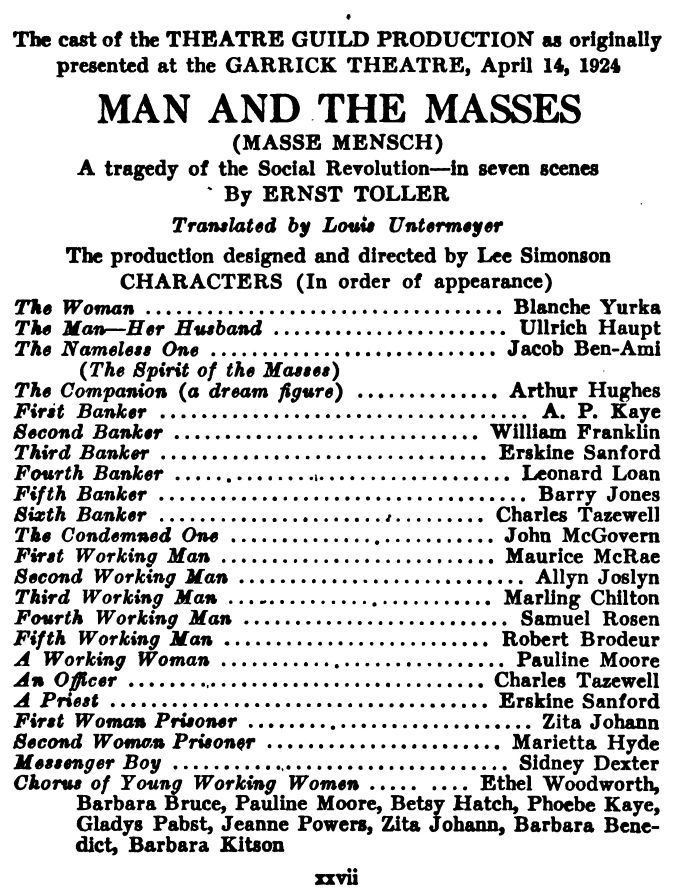
Edwin Seaver, reviewing the U.S. premiere of Ernst Toller’s 1919 play Masse Mensch (Masses and Man) written while in prison for his role in the Bavarian Soviet, says there will be greater plays on revolution in the future, but “there will never be a greater attempt.” Opening on April 14, 1924 New York City’s Garrick Theatre was translated by the Masses and Liberator’s Louis Untermand produced by the Theatrerevival.
‘A Poet Contemplates Revolution’ by Edwin Seaver from The Liberator. Vol. 7 No. 6. June, 1924.
It is past 8:15. It is growing late. The show will soon be starting. Taxicabs slide up out of the darkness for a momentary place in the electric lights of the Garrick Theatre. The door is inevitably opened by the Negro lackey who doffs his hat like a monkey, pipe dreaming of improbable tips. 8:20. Now the limousines begin to pull up. Ermined and sabled ladies trip it lightly across the crude asphalt to the theatre lobby, flurries of gossip. The gentlemen follow, canes sprouting from forearms.
The school teachers, the serious thinkers, the Guild subscribers were seated long ago. All, all, my friends, have come to see a play of social revolution.
***
The curtain rises. What the devil? Do you call this a show? Two college students dressed like laborers stand on each side of Blanche Yurka–no, of the Woman–no, of humanity–talking about a general strike. The husband enters. (I mean the state, of course, though he looks very much like a bookkeeper dressed for his employer’s funeral). He talks about duty to the state. She is torn between her own life and her love for him. And because she wants to stand on her own feet, he declares he will divorce her. He won’t have any damned radical tainting his honor.
Allons!
***
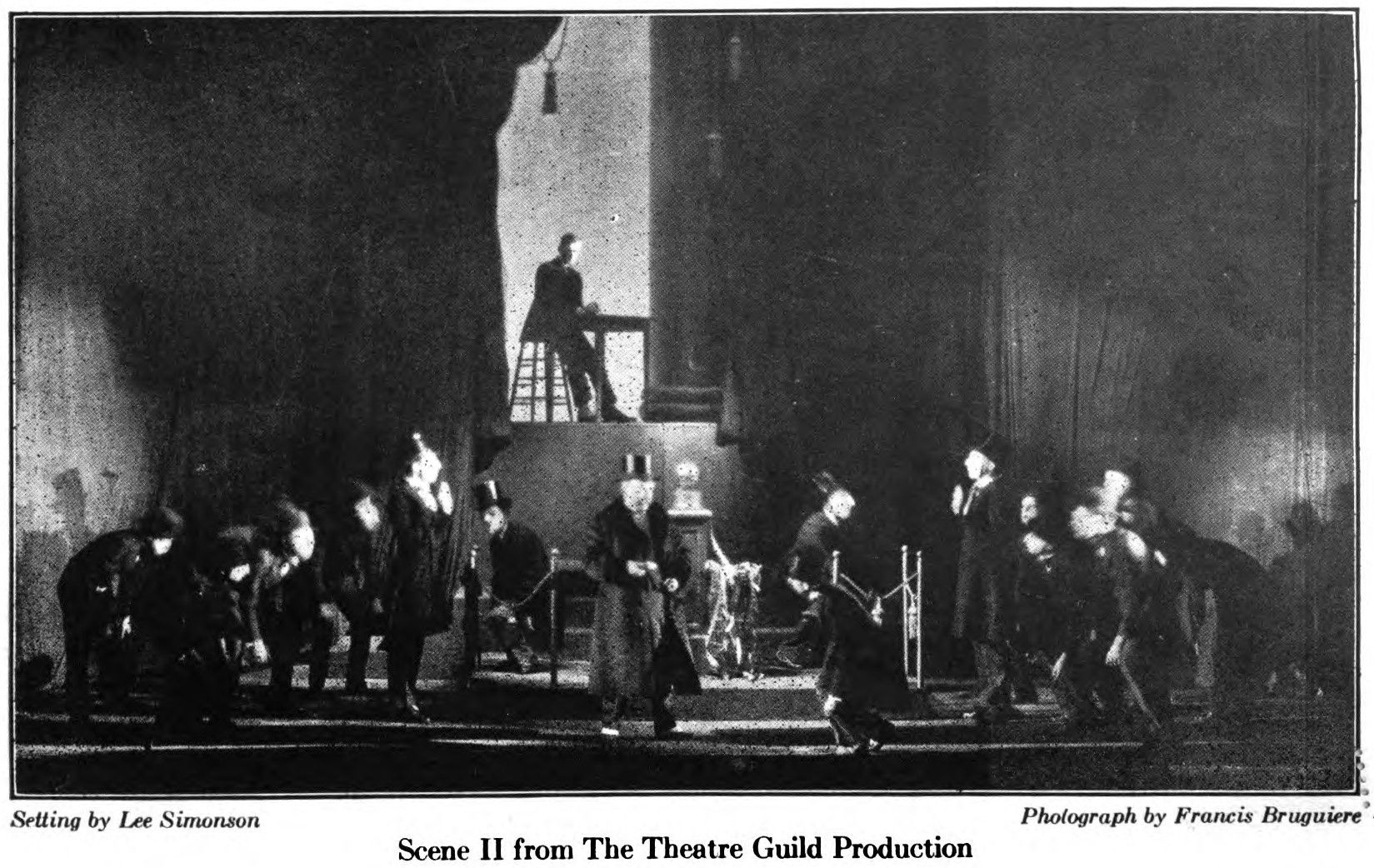
Scene two is a dream scene. The stock exchange in the Woman’s heated imagination where the ghouls (not the Goulds) fatten on human flesh. But who ever saw a stock exchange look like this? Though the fellow with the cigar does look like the elder Morgan. That’s a good one. He proposes an international brothel corporation to keep the soldiers happy. Captains stay all night; corporals one hour; privates fifteen minutes. The ghouls bid away and finally, at vespers, Morgan and company kneel down in holy worship of the recorder. The great god capitalism having been appeased, the bidding continues. In vain does the Woman plead with them to realize there are human beings upon the earth. They hear nothing. Until they hear of mine explosions and other disturbances. Whereupon, in a frenzy of generosity, the elder Morgan proposes a charity bazaar right then and there in the stock exchange with lots of booze and lots, oh lots of women.
The setting is interesting mildly ejaculates a young thing applauding perfunctorily.
***
The curtain rises again in darkness. Rises over the chant of the dispossessed crying out their woes in the black of oppressive night. The poetry, the rhythm is superb. These are the workers. But the pronunciation of the words is abominable. Or rather, it is too fine. These are only Theatre Guild supers you say to yourself. Light comes. Comes upon the Woman pleading for a general strike to put an end to the workers’ woes.
But suddenly from the masses springs a wild, decisive creature commanding the woman to be silent. It is Ben-Ami. It is the spirit of the masses. It is something awe-inspiring and superb and terrific. He calls for revolution. He calls for an end of oppression. He calls for the workers to take over the power. And expressing the will of the masses as he does, he wins the day. Unwillingly and yet, alas, only too willing to believe, she joins with the others.
The revolution is proclaimed. It is commonly agreed among the audience that the scene was very nicely presented considering the sort of stuff it contained.
***
Scene four is in the barricades. Again projected through the Woman’s fevered imagination. The gallows looms big in shadow and underneath the revolutionists execute a wild, macabre dance of freedom, of released inhibitions, of glorious, good, kind, sweet human nature with the lid off. The husband is taken out and shot. The Woman is sorry. We were not.
***
The revolution is defeated. It was bound to be. Here was no conscious leadership. Here was blind, stupid rebellion without guidance, destined to fail in its objectives since, meeting force with force, it had not the preponderance of that quality. The revolution is defeated, the workers are slaughtered, the Woman is taken to prison to be executed by those whom she cannot find it in her heart to hate.
***
Scene 6. The Woman in the Garden. Humanity on the way to the cross. Upon her seems to fall the guilt of all these helpless slaughtered ones. But she feels that the guilt cannot fall upon humanity. But it must fall somewhere. Humanity nominates God to the office. God is guilty; humanity is free from sin. The sunlight falls upon Blanche Yurka’s face.
***
The last scene finds the Woman in prison awaiting her execution. She has three chances for freedom. One, the state, which she refuses. Two, the church, which she spurns. Three, the masses, who will kill one of her killers in order that she may escape, whom she shrinks from in horror. You were born too soon, says the spirit of the Masses. She goes to her death a martyr to her faith in humanity.
***
What have we here, then? Surely not a drama of social revolution. Rather a play of the poet contemplating social revolution. Which is a distinction that cannot be over-stressed, since in that distinction homage is paid to Toller’s intellectual honesty and tribute to the truth of his poetry. He realizes that life is life, that human beings are human beings, that revolution is revolution. He is not fool enough to apologize or to condemn. But he is in duty bound to himself to speak out freely concerning the impact of reality upon his own spirit, and he does this in poetry that is great and strong and agonized, in a drama that is tremendously impressive.
***
It will be claimed by the more Orthodox that this is not revolution. That this is rather a burlesque of revolution, merely a mob losing its head and running amuck. For revolution as we know it today is a pretty scientific affair and does not rest upon mere mass explosion. That explosion must be directed, the fiery fluid stuff of rebellion must be conducted along proper channels if it is not all to be wasted and defeated. And that revolution is worth the price of life or worth nothing at all is quite ably proved by comparisons, say, of the Russian and the Hungarian revolutions.
However, all this is quite beside the point. The point is that Masse Mensch pictures a poet’s questioning of revolution. The logic of that questioning may be poor and muddled, the will to it is the will to pull away from stupidity and mob action. We may not at all agree with Ernst Toller’s conclusions. But we cannot fail to respect him as a man and as a poet, we cannot fail to acknowledge him as a truly inquiring and rebellious spirit. The questions he proposes he may not answer to our satisfaction. But the questions are always with us and must be answered by each in his time.
There will be greater plays about social revolution in time to come. There will never be a greater attempt.
The Liberator was published monthly from 1918, first established by Max Eastman and his sister Crystal Eastman continuing The Masses, was shut down by the US Government during World War One. Like The Masses, The Liberator contained some of the best radical journalism of its, or any, day. It combined political coverage with the arts, culture, and a commitment to revolutionary politics. Increasingly, The Liberator oriented to the Communist movement and by late 1922 was a de facto publication of the Party. In 1924, The Liberator merged with Labor Herald and Soviet Russia Pictorial into Workers Monthly. An essential magazine of the US left.
PDF of full issue: https://www.marxists.org/history/usa/culture/pubs/liberator/1924/06/v7n06-w74-jun-1924-liberator.pdf

