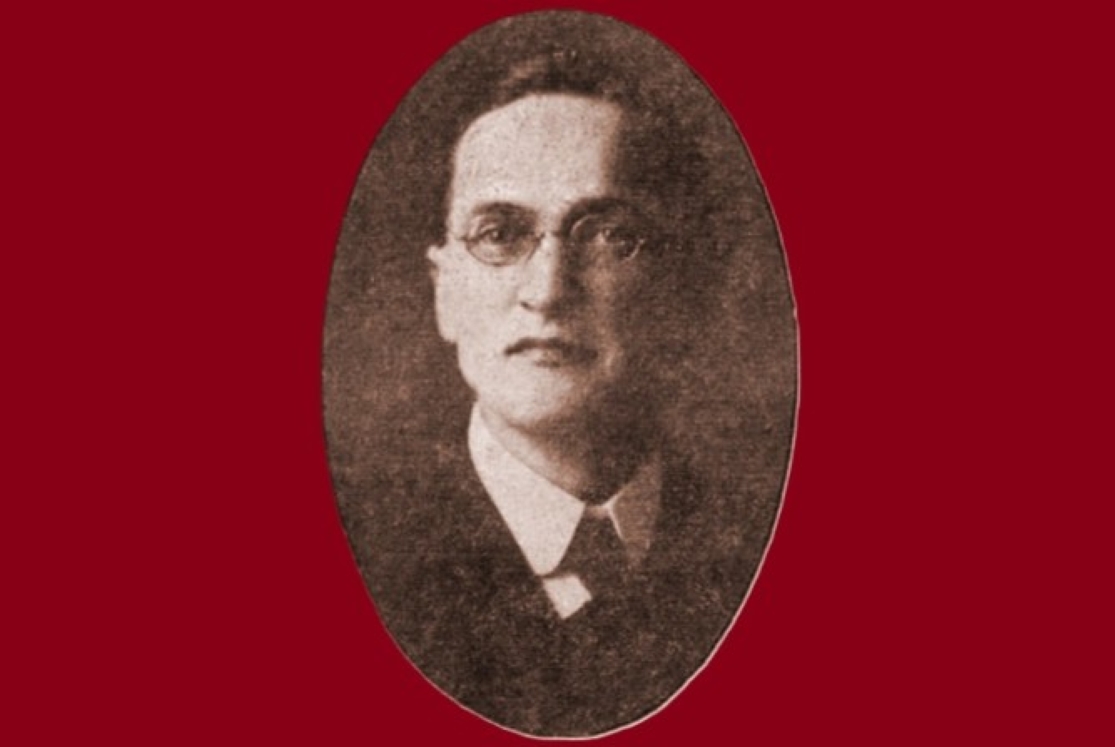
Washington had one of the best organized, largest, and most fractious Socialist Party state organizations, with control going back and forth between reds and yellows. In 1913 it was the reds leading the work, as veteran left-winger, and future Communist, the radical bookstore proprietor Frans Bostrom was State Secretary. Here he gives his report on the activity of the Party’s 6326 members in around 280 local bodies.
‘Report of the State Secretary’ by Frans Bostrom from The Commonwealth (Everett). No. 116. March 21, 1913.
STATE SECRETARY’S REPORT TO THE STATE CONVENTION
Comrades of the Convention:
It is not my intention to take up much of your time, knowing as I do, that you have a great deal of work to do. What I have to say is meant merely to remind you of the magnitude of the movement which you here represent, the destinies of which, to a very great extent, depend upon the wisdom with which you settle the important questions that will come before you, and the judgment you will display in selection of nominees for the administrative offices of our party for the coming year.
Although the growth of the party has not fulfilled my predictions of a year ago, it is nevertheless a wonderful organization, for in spite of the bull moose republicans we managed to increase our vote 183 per cent, and in spite of bull moose socialists we had an average membership of 6,326 for 1912 as against 3,984 for 1911. There is a paid up red card socialist for every 180 inhabitants in the state of Washington. To properly understand what this means, compare it with Wisconsin, where there is one member in 504 inhabitants, or with Georgia where there is only one in seventeen thousand.
There are at present about 280 living locals, of which 157 are a year or more old. One hundred and seventy-eight locals were chartered during 1912, out of which 123 are alive. In campaign years there are always a lot of locals created for the purpose of giving party standing to aspirants for political offices, and such locals are naturally predestined to share the fate of the hopes of their creators. These bi-annual locals get into the habit, however, to survive election day a little longer each time, until they finally grow into permanent institutions for 1912.
[Financial audit omitted]
***
Seeing that the campaign fund is now as large, if not larger than it needs be to pay all expenses of the next campaign, I have been instructed to bring in a resolution to this convention to be sent out to the membership by referendum, proposing to suspend section 72 for twelve months and devote that 1 per cent per member to educational purposes.
Organizers
Comrade Wanhope was employed as organizer during the whole year until election day, except during the month of September, when he was employed by Snohomish county office. Comrade Jervis worked as organizer in May, June and July, partly under the direction of Kitsap and Lewis counties. On this day after the primary election six of the nominees on the state ticket took the field and kept at it until election day.
Recognizing the fact that agitation alone is as apt to make bull moose converts as socialists, if not followed up with a corresponding amount of revolutionary education, and recognizing that our misunderstandings and dissensions are caused entirely by ignorance of the principles and aims of our movement, the state executive committee had long planned a campaign of education in the state. As soon, therefore, as election day had passed, steps were taken to place in the field six able exponents of as many different phases of the socialist philosophy. They have now been out since February 2, and the reports coming in from all parts of the state certify to the wisdom of the venture The plan includes 252 places for meetings in as many days, each place to have a speaker every six weeks. Many locals had about decided to lie dormant for a while and felt irritated because of being disturbed, but after the first lecture they have invariably demanded to have the remaining five. Whatever changes may be made in the arrangement of the affairs of the organization, it is sincerely to be hoped that nothing is permitted to occur to interrupt the good work that has been so auspiciously begun.
Woman’s Department
After one unsuccessful attempt to establish a woman’s department, the executive committee appointed Comrade Hortense Wagenknecht state correspondent and did apparently make a happy selection. I have invited her to make her own report to this convention.
Educational Bureau
Perhaps the one most important innovation accomplished is the beginning of a department now known as the “Socialist Educational Bureau,” intended to urge the election of school directors in order that the teachers may be able to teach the truth without fear of losing their jobs. We were fortunate in being able to get Comrade J.E. Sinclair, of Midland, to take hold of this work. I have requested him to report to the convention and I ask of you that he be accorded the time to explain his plans and make his recommendations, and that you give his report your earnest consideration.
Grievances
A great deal too much of the time of the executive committee has in the past year been consumed in vain attempts to settle party quarrels and in prosecution of offenders against the constitution. The most unfortunate side of this constantly recurring problem is not the loss of time, however, but rather the fact that each occasion makes a set of new enemies of the administration, which refuses to co-operate in educational and organization work, and which instead wastes its energy in obstructive activity, unfair criticism and more or less violent knocking. Realizing that if the state office is to be of any use for constructive work, it will be necessary to relieve it of the judiciary functions, the executive committee has considered the advisability of selecting a grievance committee for each separate trial, such committee to be elected from a certain number of the state committeemen of the nearest locals. The idea would be that this committee would visit the local, hold the trial, draw up and present its findings for the consideration of the state committee, through the medium of the state office and the state committee referendum.
Two cases from Tacoma, from locals No. 2 and No. 6, have been referred by the executive committee to this convention, the committee holding that they involve party treason in connection with the primary elections, and being without precedent, the executive committee desired the convention to take what action it deems advisable. Comrades Barth and Wells were elected spokesmen for the executive committee in these cases.
Referendums
This has been a referendum year. Including the referendum pertaining to the proceedings of the last convention, we had nine state referendums in 1912 and three in 1913, or between the conventions just a dozen. An innumerable amount of motions for referendums were published in the bulletin that never received enough consideration to become referendums. Nine state committee referendums were sent out. Nothing can better illustrate the recklessness with which the membership considers important questions coming before it than the fact that hardly had the state platform been adopted by a vote of 1,500 to 60, before a motion to reverse it, in regard to “Immediate Demands” was seconded and subsequently carried by a vote of about 1,350 to 250. Other referendums carried were: Refer “D” amending section 60, referendum “E” giving counties with fifty members the right to autonomy, “F” for the election of alternates for the executive committee and the board of trustees, “G,” pertaining to qualifications for party offices, referendum “H,” intending to abolish representative administration failed. So did referendum “I,” proposing the recall of the executive committee and the state secretary. Referendum “A” 1913, proposing to abolish the convention stamp was defeated, and “B,” amending section 76 carried.
By means of state committee referendums, locals Seattle 4th and 14th Wards and Bellingham North and Gig Harbor were expelled, for exoneration of party treason.
Expulsions
In regard to these expulsions I wish to point out that it is not an agreeable duty to perform, to have to ask the state committee to revoke the charter of a local and nothing but extreme necessity can induce such action. We adopt our constitutions by majority vote and minorities can not be permitted to trample them under their feet. The majority elects our party officials, and these officials, being unable to serve two masters must of necessity serve the majority, regardless of the wishes of the minority. The charge has been made that we cannot harmonize the factions of the party and it was on that plea the motion for our recall was made. The charge is true, we have never attempted to carry water on both shoulders. In a true democracy the only right that can be conceded to a minority without robbing the majority, is to try to educate the majority into the views of the minority and thus get the upper hand by numerical strength. In this the minority of the party in this state has miserably failed. It has constantly hampered the party officials in their work, it has aided, abetted and exonerated violations of our party laws and has never hesitated at using any means, no matter how underhanded, dishonest or repulsive, in trying to get the best of the majority. It has even gone to the extreme of invoking the aid of the capitalist courts and the prostituted press in its nefarious work. Having no issue decent enough to present to the membership, this minority has created fictitious ones. This issue is “Direct Action Against Political Action.” Nothing can better illustrate their rascalty. That question has never been discussed by our speakers, considered in our conventions debated in our locals or been the subject of a single motion for referendum. The question really is honesty or dishonesty, constitution or anarchy, rule by the majority of our red card membership or rule by the lawyers and politicians of Seattle and Tacoma. There is no real intelligence in their work. They seemed to labor under the childish notion that by discrediting the state executive committee and the state secretary in the eyes of the membership their victory would be won. They do not know that a dozen sets of state executive committees and as many state secretaries can be picked out from the membership of this state, one set about as good and able as the other.
Comrades, we have nothing to regret and nothing to apologize for. Select among you any responsible, active and levelheaded men and women you can think of for the party offices and they will come to you a year from now and tell you an experience similar to our. The Seattle situation is in a bad shape, but conditions cannot be improved by attempting to undo what has been done. The insurgent organization will live for a while, but will gradually break up, the leaders to join the bull moose party and the rest returning to the fold. It is time that expulsion should be made to mean something. The instigators of the Seattle trouble have, most of them been expelled on several occasions, only to bob up again and again as serene and tricky as ever. They should be kept out this time until the party has grown to a size too large for their limited capacities.
Conclusion.
In conclusion I wish to render to the majority of this party the gratitude of the executive committee and myself for the loyal support given us on all occasions, the expression of which has been our greatest pleasure and the source of courage for further efforts toward a greater, stronger and above all, cleaner organization.
We have been accused of being a ring. Every state executive committee and state secretary you may elect, who have sense enough to work in harmony will be a ring. But it is a ring elected by the membership to come together to work for the party as well as it understands. No ring, not so elected, should be tolerated in the party. This ring, comrades, is here today, ready to render an account for itself to the convention and ready to be broken up at your command into its component parts.
And I feel that I can speak for my comrades of the executive committee when I assure you that as individual members of this party, we will support our successors as loyally as we know how, as long as they stand by our constitution and serve the majority of the party.
Yours for the revolution,
FRANS BOSTROM, State Secretary.
The Washington Socialist was a weekly newspaper of the Socialist Party of Snohomish County published in Everett, Washington and edited by Maynard Shipley. Closely aligned with the Industrial Workers of the World, who were strong in the Pacific Northwest’s lumber industry, the paper ran for only 18 months when it was renamed The Northwest Worker with Henry Watts as editor in June, 1915, and again Co-Operative News with Perter Husby as editor in October, 1917. Like virtually all of the left press, the Co-Operative News was suppressed in June 1918 under the Federal Espionage Act.
PDF of full issue: https://chroniclingamerica.loc.gov/lccn/sn84025731/1913-03-21/ed-1/seq-1/
 Revolution's Newsstand