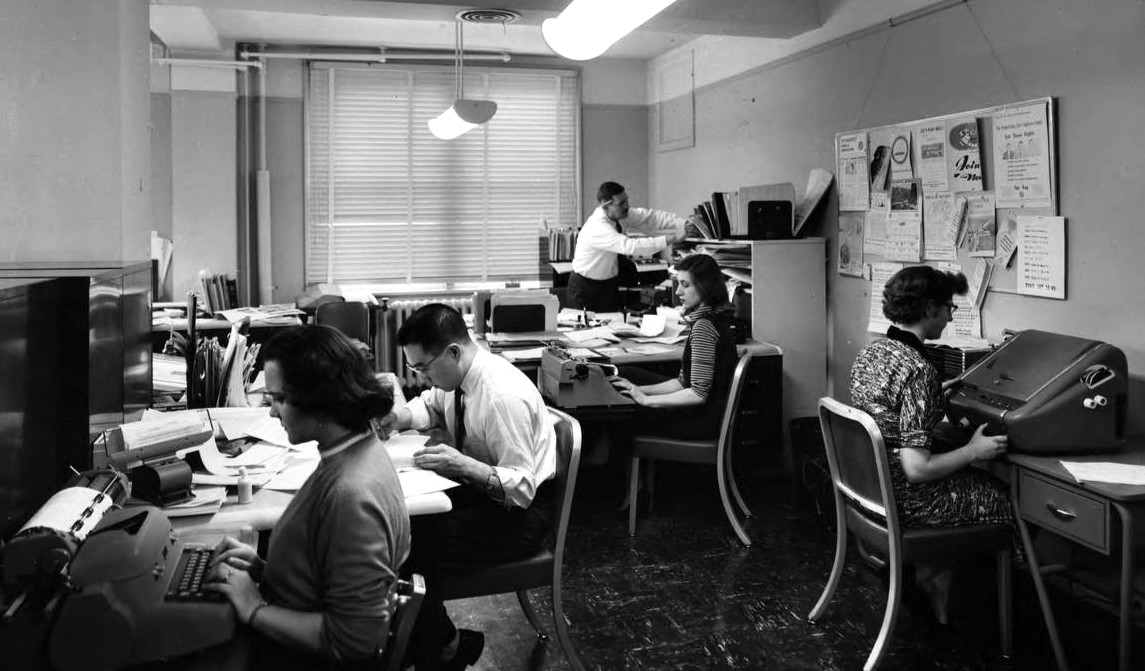
Breaking down the constructed divisions between intellectual and manual labor has always been a cornerstone of the Communist outlook. An early Red International of Labor Unions leader speaks to its immediate dynamics then.
‘The Relation of the Brainworkers to Communism’ by A. Mayer from International Press Correspondence. Vol. 1 No. 2. October 17, 1921.
There may be some comrades who think it unimportant or even useless to appeal especially to government employees and clerical workers during a propaganda week of the Communist International. Such comrades point to the conservatism and the stubborn sectarian spirit, to the indifference and untrustworthiness in matters pertaining to politics and trade-unions, and to the petty ambitiousness, prevailing among these groups of employees. They try to give weight to their opinion by saying that the emancipation of the working class can only be accomplished by the working class itself. Others point to the untrustworthiness and sabotage of the government employees and clerical workers in Russia and even demand that these categories of workers be not admitted to membership of the Party. All those advocating a policy of that description harbour an honest but purposeless hatred against everyone generally referred to as an intellectual.
Which, then, is the right road to follow? First of all we must ascertain whether or not the brainworkers belong to the bourgeoisie proper, i.e. to those exploiters of the working class, who for their own purposes use the surplus created by the proletariat. Only an insignificant number of the government employees and clerical workers, the majority of whom belong to the upper category, is possessed of wealth, by heritance or marriage, and thus share in the benefits of exploitation. Amongst these are to be counted managers and superintendents, etc., etc. who share in the profits and draw exceptionally high salaries. The majority of the new middle-class so-called has grown and is growing with the development of industry and, in so far as its economic situation is concerned, there is little or no difference between it and the working class. It is a well known fact that the standard of living of the majority of the government employees and office workers is even below that of certain elements of the manual labourers. The lack of organisation and, where organisations exist, the lack of militant spirit in them are the reasons for a continuous decline in the living standard of the great majority of brainworkers. The economic security formerly enjoyed by government employees and office workers is gradually disappearing, the extensive economic crisis having affected them as badly as, and at times even worse than, the manual labourers. If one but goes to the offices in the various cities, where the meagre pittances for the unemployed are handed out, one will find among these unemployed an exceptionally large percentage of office workers. While acting in the capacity of counsel and advisor to government employees and as a parliamentarian while in Germany, I found occasion to become acquainted with the wretchedness prevailing amongst the families of unemployed office workers. As a rule, they suffer more than the manual workers, because many of them never expected that the economic crisis would also affect them and had no opportunity of saving money. All of them are proletarians in the true sense of the word.
The objection is sometimes raised that the relationship between the bosses and the office workers differs from that of the bosses and the manual workers. It must be admitted that during the earlier phases in the development of industry a certain harmony of interests between the employer and his office employees existed. Excepting a few cases, however, this harmony has disappeared, and now the relations between office workers and the employer are the same as the relations between the manual labourers and the employer. The relations between the employer and the clerical employees are in many cases even more strained than those of the manual employees to the employer. The times when preparatory training, a position in society, long time contracts, the spirit of fellowship and other things played an important part are today but things of the past. This contention was proved by the deputy Heine in a speech in the Reichstag as early as 1907, although at that time all government employees and clerical workers still believed in the fairy tale entitled “the harmony of interests”.
It is understood that in social-political matters the legislative activities of a class state can be nothing but poor, miserable patchwork. The state, the representative and protector of the capitalist class, is versed in all the tricks of deceiving the brainworkers by reformist measures as to their true position. Clerical workers were not even permitted to share in the benefits accruing from the struggles of the working class (shortening of working hours, rest on Sundays etc., etc.), exceptions having been made to their disadvantage. It is an undisputed fact that, as a rule, state and employer display unprecedented contempt for their employees and adopt very harsh measures against them, if they threaten to become unruly. The employers take for granted the ethical duty of government and clerical workers to form the elements of balance in society and will under no circumstances whatsoever permit them to shift the balance, no matter how miserable their situation may become. Thus, so-called educated men and women are charged with the “ethical” task of keeping up the social balance and at the same time must be satisfied with a meagre crust, the whole of this being commonly called “living according to one’s social stratum”. Humble petitions and begging letters are no longer effective.
The situation of government employees who seemingly are assured of a secure existence, really does not differ from that of the office workers. The remuneration drawn by the majority of them is so small as to place them among the lowest paid part of the proletariat; only very few of them are drawing salaries enabling them to provide a decent standard of life for their families. The masters have always encouraged the sectarian spirit prevailing among the government employees and thus made it impossible for them to unite and exert the force of their numbers. Even the smallest attempt at improving their situation has always been ruthlessly suppressed by the class state, with the willing assistance of the would-be socialists.
One has only to mention the notorious patent-right and the infamous clause regarding competition, and we see the contempt of bourgeois society for those who work for it with their brains. Here we are face to face with an exploitation and a theft of intellectual property which place the employees at the mercy of their employers.
We see, then, that the economic situation of the government employees and of the office workers is far from being favourable and that an intensification of the crisis tends to make matters worse for them. Great numbers of them are engulfed by the wave of deterioration and doomed to misery. If one but goes to the industrial centres and to the metropolis and compares the statistical figures compiled by a number of physicians and looks into the children’s homes and schools, a terrible picture will roll itself: a great many children of government and clerical workers are undernourished.
The government employees and the office workers are the pillars of yellow federations and always side with the bourgeois reactionaries? Yes, quite right. But we are not only concerned with their present political position and their state of mind, it is their position in the process of production we are most interested in. Though the class state has, by means of its schools and other institutions, clouded the brains of the majority of its employees, it is not to be denied that the occurrences of recent years have left an impression upon many of them. Some of those engulfed by the wave of new thoughts have found their way back as soon as reaction was given a fresh lease of life; of these many went to the other extreme. He who knows these people does not wonder at that; he looks upon it as the result of decades of mental inertia and of the utter absence of political and organisational training and, finally, of the ingrained habit of an “obedient, irresolute and ambitious servant”. This want of self-reliance and firmness of character is often repulsive to class conscious workers. The petty ambitiousness manifesting itself when the waves of revolutionary sentiment go high fills every proletarian with disgust. That is the reason why many comrades warn against government employees and office workers.
Can we allow ourselves to be against them? I say, no! If it is an undisputed fact that the great majority of government employees and office workers economically belong to the proletariat, if, furthermore, we know the causes of their lack of political conviction and organisational training and have ascertained the relations obtaining between employer and employees, we must endeavour to understand the results and, accordingly, change our attitude. We have for decades waged a war against the inertia of the broad masses (a struggle which even today absorbs a great part of our work and energy) and will as surely struggle with the weakness and the inertia of this part of the proletariat as well.
Look at Russia! There can be no doubt that matters would have progressed more favourably, if at the beginning a modest percentage at least of the intellectuals had consciously sided with the Bolsheviki. If that had been the case, many a blunder and many a set-back would have been avoided; economic reconstruction would doubtlessly have been furthered considerably, especially in a country lacking the category of highly skilled workers who could have formed the communicating element between the prominent leaders and the broad masses; much of the economic structure could have been preserved for the proletarian state. The state of affairs in which the intellectuals today are drawing exceptionally high salaries, is by no means healthy, even though it is necessary in order to make use of the intellectuals for the purposes of the proletarian state.
In Western Europe we must do everything in order to win for us, a part of the intellectuals, previous to the revolution. This we think imperative because of the highly developed technique and of the vastness of the various domains of economics, and in spite of the fact that we have no lack of highly skilled workers. Already, the beginnings have been made; economic pressure has guided quite a few intellectuals to our ranks. Let us as quickly as possible expel obvious place hunters from the parties, let us employ cautiousness against every intellectual, but let us not forget the one outstanding fact: we cannot miss that part of the proletariat in transforming the economic structure.
We must always consider this fact in our agitation and propaganda and adopt our tactics accordingly. Although success will not be visible immediately, we should not allow ourselves to forget the effects of the propaganda. Even if it proves impossible to win the majority of government and office workers as active fighters for our ranks, there still remains the possibility–and experience teaches us that it is possible of filling them with distrust against their mode of thinking. Thereafter they will cease to be active enemies and become neutralised. When considering the intellectuals and the part they are to play in the revolution, I divide them into the following four groups: active Communists, sympathisers, non-partisans and active counter-revolutionaries. The greater the number of non-partisans, the better are the chances for getting rid of the active counter-revolutionaries, during and after the revolution.
When, in the years past, the bourgeoisie fought for its freedom, the students were the first to render assistance. Today, this class, with the exception of a insignificant few, sympathisers with us, is the shock-troop of reaction. Colleges and universities have become bulwarks of the White Terror. The sons of the bourgeoisie prove their class consciousness by deeds against proletarians. The great majority of employees, seeking a way out, but resenting the employment of force, herd with the would-be socialists and push them, always willing to conclude compromises, more and more into the bourgeois mire.
Hence, it is our task to tear a gap in this wall of inertia and to sot forth the necessity and the exalting feeling for struggle. It is our task, furthermore, to make government employees and office workers see that they can extricate themselves from the fangs of the exploiters only by means of a decisive class struggle. We must make it quite clear to them that the final liberation is not possible without the Dictatorship of the Proletariat and that only the Communist Party, the most militant and class conscious party, can lead this struggle and realise Socialism.
Comrades, approach the intellectual proletarians! Rally to work!
A. Mayer, Member of the Executive Committee of the RED TRADE UNION INTERNATIONAL.
International Press Correspondence, widely known as”Inprecor” was published by the Executive Committee of the Communist International (ECCI) regularly in German and English, occasionally in many other languages, beginning in 1921 and lasting in English until 1938. Inprecor’s role was to supply translated articles to the English-speaking press of the International from the Comintern’s different sections, as well as news and statements from the ECCI. Many ‘Daily Worker’ and ‘Communist’ articles originated in Inprecorr, and it also published articles by American comrades for use in other countries. It was published at least weekly, and often thrice weekly.
PDF of full issue: https://www.marxists.org/history/international/comintern/inprecor/1921/v01n02-oct-17-1921-inprecor.pdf

