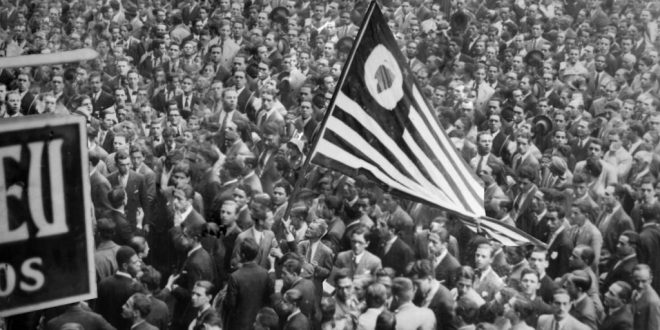
A revolt in São Paulo against the dictatorship of Getúlio Vargas leading to a brief civil war is analyzed in the context of the fierce imperialist rivalry for dominance over the country between Britain and an increasingly belligerent United States.
‘Insurrection and Civil War in Brazil’ by R. Kölner from International Press Correspondence. Vol. 12 No. 39. September 1, 1932.
In spite of the watchful censorship, reports leak through in increasing numbers on the ever-increasing extent of the insurrection which broke out on 9th July against the Vargas dictatorship. Whilst the official news published by the Brazilian government are few, and report solely on victories, maintaining obstinately that the government is master of the situation, the reports coming via Uruguay and Argentine, as also those directly from the headquarters of the insurgents, report precisely the contrary.
However contradictory all these reports may be, at least it can be definitely stated to-day that the rising, which commenced in the world’s coffee centre in the state of Sao Paulo, is now on the point of spreading to two further and very important states of Brazil, Minas Garaes and Rio Grande Do Sul. These states rule over 80% of the economic life of Brazil, and if they come completely under the sway of the movement, the issue of the struggle is not likely to be doubtful. The insurgents have already troops to the number of about 70,000, are excellently equipped, receive constant reinforcements from all other camps, and are said to be led by a German adventurer, General Berthold Klinger.
The insurgent movement has been given a decisive turn by the revolts in the governmental capital Rio de Janeiro. Here there were great anti-war demonstrations and mighty partial strikes, which were carried out against the instructions of the reformist trade unions. The government took the most brutal measures, proceeding against the demonstrators with machine guns and tear gas bombs, costing much bloodshed. It was not until hours of struggle, however, that the police and soldiery succeeded in dispersing the demonstrators and in regaining possession of the occupied buildings. A state of siege was imposed over the whole of Brazil.
A glance at the pre-history of this revolution enables the present situation to be better understood. Getulio Vargas, the present Federal President, belongs to the state of Rio Grande Do Sul, and obtained his present position by means of a revolution, seizing upon it by force of arms against the elected president Julio Prestes. Prestes, who attempted at that time to win over the masses of the working population by means of a program richly decorated with socialist phrases (precisely like Davila in Chile today), was obliged to retire.
He aroused but little enthusiasm in the working masses with his program. The Communist Party of Brazil at once drew a sharp line of demarcation, and enlightened the masses on Prestes intentions. The actual cause of his downfall was, however, the intervention of U.S.A. capital.
Vargas gained the presidential seat, issued a great program promising nine great parliamentary reforms, failed to keep even one of these promises, and imposed a ruthless military dictatorship. When his presidential chair began to become alarmingly unsteady last year, he promised the immediate convention of a national assembly, but did not feel it necessary to fix any date for this. In 1930 it was a revolution supposed to be directed against the large landowners which gave Vargas his position, and now it is a revolution allegedly anxious for the establishment of democracy which is to deprive him of his post. In actual fact there is no question today of “exalted social and democratic aims”, any more than this was the case in 1930, but simply of a struggle for the utilisation of the influence of U.S.A. capital in Brazil. The military insurrections, when looked at closely, turn out to be a part of the conflict, felt all over South America, between Yankee imperialism and British imperialism. The struggle for the great markets of South America has now become so acute that recourse is being made to force of arms.
Brazil’s economic situation in the midst of the general crisis is one of the worst. Sao Paulo, the centre of the present rebellion, is most severely affected. The state of Sao Paulo is the greatest coffee producer of the world. Brazil lives to 60% from coffee export. Exports have now fallen off steadily, millions of kilos of coffee lie in the warehouses, prices have fallen to nothing, coffee mixed with tar is used as fuel, millions of sacks are simply thrown into the sea. The state undertook the experiment of raising the value of coffee, an extensive action in aid of the price. The coffee crops were no longer put on the market, but stored in state warehouses, in order to be sold slowly in the course of twelve months. It was expected that this withdrawal of coffee from the market would raise the price to one more agreeable to the coffee producers. But the general crisis brought with it a stagnation of sales, whilst production increased. The sacks accumulated in the storehouses, and 24 million sacks of coffee lay in gigantic piles, threatening the existence of the Brazilian state, whose finances could not stand such an accumulation.
U.S.A, capital had been waiting for this moment, as an opportunity to overthrow the British monopoly of Brazilian coffee production, and to work its way for itself into this profitable branch of production. The Brazilian loans in aid of the revaluation of coffee found no subscribers on the U.S.A. exchanges. The United States commenced to grow coffee for themselves spheres of influence. This was the last straw, and the coffee revaluation experiment collapsed. The Yankees, in order to push their influence, supported Vargas’ coup d’etat under the pretext of aiding the movement against the large landowners. In 1930 they would have aided Prestes just as willingly, had it served their aims. Today they are again supporting a revolution, allegedly for the purpose of overthrowing a dictatorship and replacing it by a democratic constitution. They will use any tool which will help them to make a breach in Britain’s monopolist position and to strengthen the influence of the United States on the South American continent.
Those who have to suffer under these struggles, risings, and revolts are the toiling masses of Brazil, who have to live on a level scarcely imaginable. Wages have been reduced by 60%. Workers on the coffee plantations earn about 150 Milreis yearly. A whole family, in which the whole of the members work, has to live for a whole year on 800 Milreis. Unemployment increases rapidly; there is no official registration, but private reports state that there are about 400,000 unemployed in the state of Sao Paulo alone. These unfortunate beings, starving and in rags, not knowing what they are to live upon, have been up to now a plaything in the hands of the warring cliques, the lackeys of the imperialist ruling the country.
This has now changed greatly. The working masses are awakening. The demonstrations in Rio de Janeiro prove-like the great labour movement in Chile and the risings in Peru and Ecuador,–that the workers of these countries are beginning to grasp that none of these frequent bourgeois revolutions can solve the social question. The present revolution in Brazil is as little a revolution of the progressive industrial bourgeoisie against the backward feudal bourgeoisie as that of 1930; it is merely the struggle of one clique against another clique which has the power in its hands at the moment, a struggle between the wirepullers of these cliques of the foreign imperialists. It is obvious that such a revolution can solve neither the crisis nor the social question. This can only be done by a workers’ and peasants’ revolution, and the toiling masses of Brazil and of the whole of Latin America are urging towards this.
International Press Correspondence, widely known as”Inprecorr” was published by the Executive Committee of the Communist International (ECCI) regularly in German and English, occasionally in many other languages, beginning in 1921 and lasting in English until 1938. Inprecorr’s role was to supply translated articles to the English-speaking press of the International from the Comintern’s different sections, as well as news and statements from the ECCI. Many ‘Daily Worker’ and ‘Communist’ articles originated in Inprecorr, and it also published articles by American comrades for use in other countries. It was published at least weekly, and often thrice weekly. Inprecorr is an invaluable English-language source on the history of the Communist International and its sections.
PDF of issue: https://www.marxists.org/history/international/comintern/inprecor/1932/v12n39-sep-01-1932-Inprecor-op.pdf

