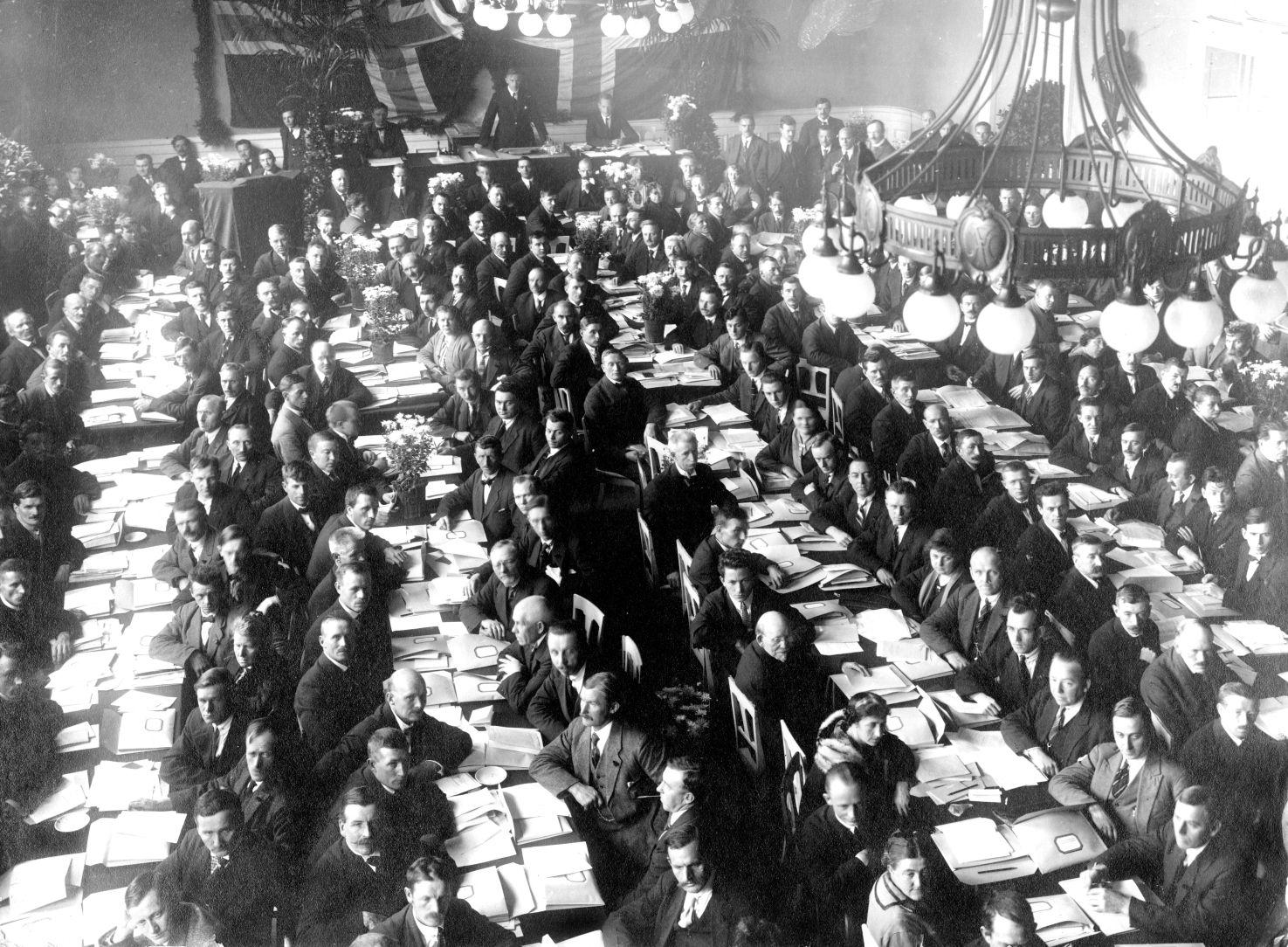
Norwegian delegates report to the Fourth World Congress on developments for that country’s working class and its organizations since the Third Congress. In 1919, Norway’s Labour Party, with tens of thousands of members in a continuum of tendencies from left to right, joined the Comintern as a body. With the inevitable schisms leading to a pro-Second International faction leaving in 1921, and in 1923 a further differentiation between right and left resulted in a Norwegian Communist Party.
‘The Norwegian Labor Movement 1921-1922’ by E.W. Bull and Trond Hegna from International Press Correspondence. Vol. 2 No. 98. November 13, 1922.
The war rendered the economic life of Norway unique. The merchant marine, the fisheries, and export industry brought millions into the country; everywhere there was diligence and activity. The prices increased somewhat in the same measure as on the world market. But wages also increased although much later and more slowly and there was almost no unemployment. Only officials, functionaries, and those with fixed incomes were affected by a real scarcity and the economic degradation of these classes was obvious.
The collapse began in the middle of 1920. The demand for tonnage which the war had created disappeared and a great portion of the merchant marine was obliged to remain idle. The price of metal fell and the mines were in a state of stagnation. The celluloid and the timber industry found no market for their great stocks. The factories came to a standstill and the cutting of timber in the forests ceased. The fisheries found no market for their produce and great quantities of spoilt fish had to be thrown into the sea.
In 1920 exports amounted to 1,250 million crowns and in 1921 to 576 millions. Imports in 1920 amounted to about 3,000 million crowns and in 1921 to 1463 millions. The number of failures and shut-downs showed a corresponding increase. (Failures: 1918–110; 1919–190; 1920–421; 1921–1001. The first 8 months of 1922–720.)
Unemployment increased from 2,3% of the total membership of the trade unions in 1920, to 17,6% in 1921.
The budget of 1922 already shows an actual deficit. In order to effect a balance the bonuses paid to the officials and functionaires on account of the high prices have been considerably reduced and the customs increased.
As most other countries, the war prosperity was accompanied by inflation. The normal limits of the rights of issue of the National Bank (Norges Bank) were over-termed. The currency fell, and on the Christiania Exchange the dollar was quoted as follows: (Par 3.73); January 1921–5.40; September 1921–5.16; January 1922–6.30; September 1922–6.05. The present heads of the National Bank have decided to carry out a policy of deflation, and thereby restore the Norwegian crown to par. But since the industries are greatly in debt and the Municipalities and the State have increased their debts fourfold and sevenfold respectively, the deflation policy will cause great difficulties for productive economy.
Position of the Workers–Trade Unions.
The economic depression has of course been accompanied by a fundamental alteration in the position of the worker. Unemployment has set in to an unprecedented extent. The employers raised the cry for wage reductions and immediately began to carry out considerable wage reductions.
In 1920 the wages of the mass of the workers were settled by arbitration awards. The liberal government of that time had on its program arbitration awards in the event of labor conflicts and with the support of the conservatives, it brought in a provisional law for this purpose against the Social Democrats. The liberal government wished to win the sympathy of the workers for the arbitration system, and the awards in every way corresponded to the demands of the workers. The awards were to be in force for two years, until March 1922. The year 1921 would accordingly pass without great labor conflicts.
This was not the case, however. At the end of April 1921, the wage agreement between the shipowners and the men expired. The employers immediately demanded considerable wage reductions. The men declared a strike. As there was great unemployment in the shipping industry the issue of the strike was doubtful and the trade union therefore proclaimed a sympathetic strike. Only a few trade unions were not involved in this strike; chiefly the railway workers.
The great strike in the Summer of 1921 lasted 14 days. Among the bourgeoisie a considerable nervousness was to be observed and the fighting morale of the workers was very good. Conflicts with the police occurred. But the workers were not organized for this struggle and calm was immediately restored. After 14 days the workers returned to work. The negotiations that followed resulted in an immediate 12% reduction of wages, and 5% from the 1st of October. The employers had demanded an immediate reduction of 33% and 25% from the 1st October. The great strike therefore ended with a compromise. In reality it was a defeat for the workers. The trade unions had entered the strike with the slogan: No wage reductions!, they wished thereby to establish a principle and in spite of this the strike ended with a reduction of wages. It should also be added that the general feeling of the workers was that they had suffered a defeat. Disappointment marked the Norwegian labor movement henceforth. The rest of the economic struggle which the Norwegian workers have conducted in the year 1921 are not very important. The most important is the strike in the wood and paper industry which ended in a wage reduction of about 20 per cent.
For the majority of the workers the time of decision was in March 1922, when the arbitration awards of 1920 expired. It was obvious that the employers had decided on great reductions. The arbitration law which was provisional and only applied for a year was again introduced into Parliament by the liberal government. In the Autumn of 1921 the parliamentary elections took place with the result that the Conservative Party (Industrial and agrarian conservatives) obtained 74 seats, the liberals 39, the Social Democrats 8 and the Communists 29. It was evident that the Conservatives would vote against the bill.
The trade union executive had made no preparations to encounter the great decision in the Spring. The trade union membership was greatly reduced as a result of unemployment (from about 150,000 in April 1920, to 90,000 in December 1921). The trade union leaders were therefore not disposed to enter upon a great struggle and requested the Social Democrats and Communists in Parliament to vote for the bill for compulsory arbitration. Both fractions complied with the wish of the trade unions. The law was passed and immediately came into force.
All this happened in the first months of 1922. The arbitration court immediately assembled and is still in session. The wages in one industry after the other have been fixed. The general result of the decisions already reached are: The eight hour day has been maintained, the holidays been reduced from two weeks to one and a general reduction of wages by about 30% has been effected. The awards are valid for one year. The same applies to the law regarding the arbitration court itself. In the Spring of 1923 therefore, the Norwegian workers will be faced with the same decision as in this year, and whatever else may happen it is not likely that the workers’ organizations will again accept the compulsory arbitration law.
The inner history of the trade unions is determined by the struggle between the Social Democrats and the Communists. The majority of the craft unions are Communist and are collectively affiliated to the Labour Party. There is still a strong Social Democratic element in the trade unions, particularly because a great number of the functionaries and leaders are Social Democrats, although the mass of the workers belong to the Communist Party. It is for this reason that they have delayed affiliation to the Red International of Labor Unions. This delay led to a conflict with Moscow in the autumn of the 1921 and when this conflict was adjusted, 23 trade union functionaries in leading positions, published a protest against the Communist Party and Moscow. Another disputed question is that of the transformation of the trade unions from craft unions into class unions. In order to express the narrow craft interests through the interests of the whole class there were to be se: up organizations consisting of the whole mass of the workers in every town; the old craft unions should continue, however. The Social Democrats oppose this arrangement but the Communists are its main supporters. Thus there is a new conflict in the life of the trade unions.
During the Summer of 1922, many of the biggest craft unions have held their congresses; although most of them have recommended the new form of trade union organization, as well as affiliation to the R.I.L.U. it is still evident that the Social Democrats still form an influential element in the trade unions. Doubtless many difficulties will result from this in the future.
The Political Labor Party.
From 1910 onwards there has been a conflict between a radical and moderate tendency in the Norwegian labor movement. In 1918 the radical element won a decisive victory, captured the whole party executive and in the following year affiliated to the Third International. When the theses of the 2nd congress were published and the Norwegian Labor Party accepted these theses, the moderate element broke away from the party and formed its own party,–The Norwegian Social Democratic Labor Party.
The Social Democratic Party was not numerically an important fraction of the old Norwegian Labor Party. The number of its supporters was insignificant in most of the local sections of the old party.
Only in the district on the east side of Christiania Fjord (Ostfold) did it have a firm majority. The Social Democratic Party is therefore essentially a local party; the party has no future nationally. An idea of the status of the Social Democratic Party is to be gotten from the figures of the last parliamentary election: Social Democrats 83,000, Communists 192,500, total number of electors 905,000. The result in Ostfold was: Social Democrats 9,200, Communists 3,250, total number of Electors 33,250.
The Communist Party is the old Norwegian Labor Party; it has at present about 60,000 members (in 1919 165,000).
The trade union members form the bulk of the party. The party is now preparing for its transformation into a real Communist Party organization with individual affiliation of the members. This however lies in the future. The form of the new organization is a problem which is keenly debated.
The parliamentary election of Autumn 1921 was a great mobilization of the party forces. The election must be regarded as a significant victory for the party. The Norwegian Labor Party came out the second party in the country and received 29 mandates in Parliament.
The composition of the newly elected parliament which assembled in January 1922 was of momentous importance. The votes received by the respective parties have already been mentioned. The government party had only 39 votes and the liberal government would have had to resign if it were not supported by the Communists and Social Democrats. Many comrades thought that a conservative government was worse than a liberal one and that therefore, they must not help overthrow the liberal government. This tendency gained the day. The vote of censure was not moved.
The slogan of the united front issued by the Communist International also caused disputes in the Norwegian Labor Party. The one tendency (the same which supported the arbitration law) considered that the slogan of the united front carried with it the direct request to the Social Democratic organizations for a united struggle and that the Communist Party must conduct such a policy. The other tendency considered that the united front had already been realized in Norway through the organizatory cooperation between the Norwegian Labor Party and the trade unions (Mutual representation in the central committees takes place, and the party receives considerable support from the trade unions). Thereby the party comes into constant contact with the mass of the workers and also with those who belong to the Social Democratic Party.
The “Crisis Program” formulated by the Central Committees was also a disputed question.
Both tendencies referred to the International and the question was dealt with in the Enlarged Executive Session of June. The result was a resolution on the Norwegian question.
In this resolution the Executive adopted the standpoint of the groups which was against supporting the liberal government, and against the law for compulsory arbitration. With Tard to the question of the united front the Executive gave a clearer definition of what constituted the idea of the united front, and declared that neither side was exclusively right.
The Norwegian labor movement is at present in a difficult situation. Unemployment, the capitalist offensive, etc. But as soon as the workers’ organizations are reorganized, they will be rendered capable of beating back the capitalist offensive.
International Press Correspondence, widely known as”Inprecor” was published by the Executive Committee of the Communist International (ECCI) regularly in German and English, occasionally in many other languages, beginning in 1921 and lasting in English until 1938. Inprecor’s role was to supply translated articles to the English-speaking press of the International from the Comintern’s different sections, as well as news and statements from the ECCI. Many ‘Daily Worker’ and ‘Communist’ articles originated in Inprecor, and it also published articles by American comrades for use in other countries. It was published at least weekly, and often thrice weekly.
PDF of full issue: https://www.marxists.org/history/international/comintern/inprecor/1922/v02n098-nov-13-1922-Inprecor.pdf

