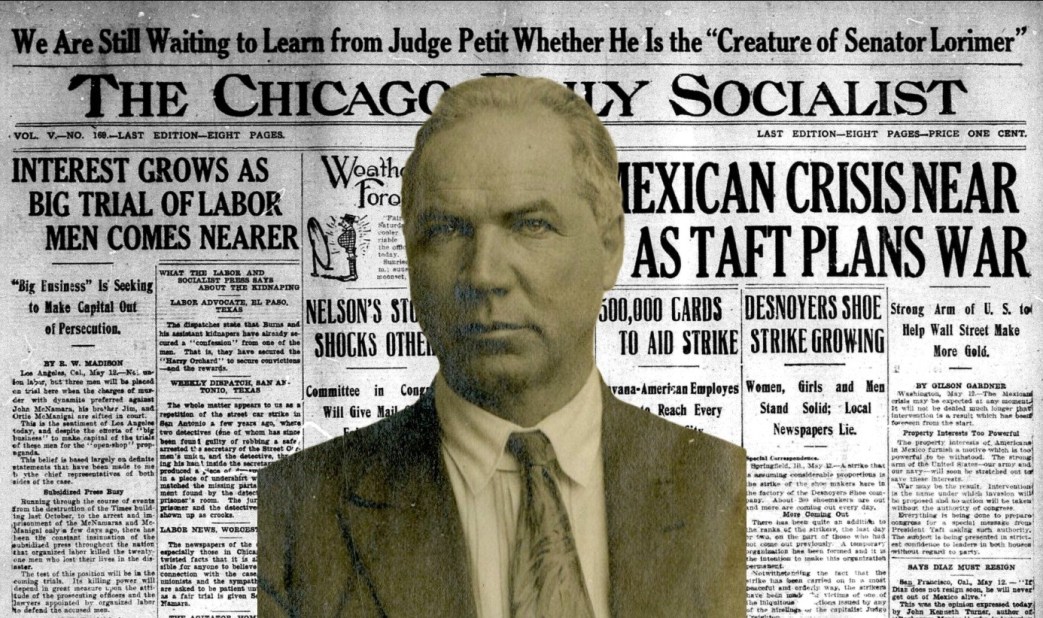
Former Illinois S.P. State Secretary and future founding Communist, Bentall on the demise, politically and financially, of one of two English-language daily Socialist papers in the country.
‘Who Killed the Chicago Daily World’ by J.O. Bentall from International Socialist Review. Vol. 13 No. 7. January, 1913.
THE Chicago Daily World, formerly the Chicago Daily Socialist, was thrown into bankruptcy on December 5, 1912, and placed in the hands of a receiver.
Many who put money into the daily, and many who have worked hard for years to keep the paper going are asking for the cause of its failure.
A naked statement of fact is due the people who have sacrificed for the daily and due the party that has backed it.
Had there not been a volley of misrepresentation by the very parties who are responsible for the suspension, this statement would not be as greatly needed as it now is. But for a management to first wreck such an important party institution and then shift the blame on innocent persons must not go without reply.
I am not going to deal with the policy which the daily pursued during the last two or three years. Leave that to the judgment of the Socialist party and let the party decide if it wants a repetition of that policy.
The management is the immediate concern of this article.
Before the newspaper lockout and strike in Chicago, the daily had struggled hard for a mere existence on account of comparatively small circulation and lack of capital. Difficulty in obtaining advertising had been experienced since the paper was started. It was no easy matter to make ends meet, but the comrades contributed from year to year enough to keep it afloat.
When the newspaper strike was called, however, a new condition arose. The other papers were entirely out of the field for several days and the World had the whole territory formerly occupied by the big metropolitan papers all to itself.
Of course, the equipment was inadequate for this temporary condition, but the little press was set in motion and was grinding out about 300,000 papers every twenty-four hours. For over one month this little giant kept pouring forth this enormous edition.
During this time the business manager kept his head pretty cool, so that during May and June the manager reported a surplus of about $10,000. But a cry came from the managing editor, E. Val Putman, recently a Hearst employe and a late candidate on Hearst’s Independent ticket, that more editors were wanted, and more presses, and more everything.
Fancy salaries with lots of overtime and extras became the rule of the house. Fifty people were put on in the editorial department, fifty in the advertising department, over thirty in the business department, eight janitors and a like proportion in other departments; in all 275 people were on the payroll.
Add to this an enormous telegraph and photograph and electrotype expense. Add $333 a month rent for a want ad room and $250 a month for a basement pressroom under the Post building, besides the regular quarters, making a total rent of over $14,000 a year.
On the 21st day of July I made a full statement of these and other extravagances to the Cook County Delegate committee, warning them of impending ruin, pleading for retrenchment and a sane business policy. As a member of the board of directors at that time I protested against the practice of the fearful recklessness of the majority of the board, John C. Kennedy, Seymour Stedman, Mary O’Reilley, W.E. Rodriquez and J.P. Dolson. I showed the symptoms of utter abandon, such, for instance, as voting Editor Putman over $130 for one month’s downtown expenses for eating, drinking and sleeping in addition to his regular salary.
The delegate committee agreed with me and ordered retrenchment, but the majority of the board, made up of the above mentioned comrades, have always defied the party and acted against its instructions.
Two big presses were added and a stereotyping outfit secured amounting to over $25,000. Carpenter work one month alone, covering some minor changes in the building was reported at over $3,000.
Attorneys’ fees to Mary Miller for $1,296, of which $800 were paid, and Clara Christensen for $950, of which $500 were paid, show another leak which could have been avoided by calling all of the lawyers of the party together and asking them to undertake the work in question.
Finally, the management got into such close quarters that it had to borrow money or suspend. This was in the latter part of July.
A promoting concern was found which promised a loan of $10,000. To secure this the attorney for the concern was given $800. In addition thereto the board spread a resolution on its minutes giving the loan concern stock to the amount of $102,000 as collateral security, thus putting by far the majority of stock into the hands of this loan concern. This was done in violation of the express instructions of the delegate committee that stock should not be disposed of in such quantities as to jeopardize the control of the society by Cook County. Information concerning this transaction was withheld from Cook County for three months.
Moreover, this resolution is in the minutes of a meeting held on the 18th day of July. I was present at this meeting and am recorded voting against the squandering of money and other reckless motions. The resolution giving away the stock of the daily was, however, not brought up while I was at the meeting, but was either passed after I had left, or added after the adjournment of the session. Not until I returned from the campaign down state, in November, did I discover this miserable piece of work.
The $10,000 first borrowed from the loan people grew to $15,000, then to $18,000 and then into sums aggregating over $130,000. Part of this was paid back from time to time and new loans made. From the time the first loan became due the loan people put their own men in charge.
Comrade Leissemer, who was at the head of the advertising department, was let out by one Harrison M. Parker, former business manager of the Chicago Tribune and a son-in-law of Stubbs, the Union Pacific railroad king.
Parker was no small man. His attorney represented him as the greatest newspaper man in America and that while with the Tribune, Parker received the fancy salary of $23,500 a year, and was now worth much more to the Daily World.
This Parker put one Price, of the Tribune, and one Searsey, of the Hearst papers, on the advertising payroll at $35 a week each. These two gentlemen were getting $80.00 a week at the Tribune and Hearst papers and were paid the difference by some parties not yet revealed to the Socialists of Chicago.
Having gotten control of daily, these creditors now ran the whole outfit as they pleased. They came up to the delegate committee and asked even impolitely to be given the paper and the outfit in name as well as in fact, and that the party give its moral and financial support to them in their service of running a nice Socialist paper.
An agreement was reached to this effect between these good capitalists and the board, myself and comrade Dreifuss protesting.
Before the Delegate Committee, Stedman, Dolson, Kennedy and Mary O’Reilley argued that the only salvation of the daily was to transfer it to these nice capitalists, assuring , the Socialist party that a perfectly good Socialist and trades union paper would be published by making a contract that Cook County could dictate the policy.
The Delegate committee turned down the proposition and declared that it was better that the paper die than to make it a power in the hands of the capitalists.
When the party refused to sell out, these capitalists began to pull off. They had already secured lien on the accounts to the amount of over $85,000, which they still hold. The amount due them at present is about $70,000, so they are well secured.
When the bond issue, amounting to ever $33,000, came due on December 1st, these capitalists wanted to put the bondholders, off and exchange the old for new bonds. Most of the bonds were held by comrades, many of whom had given their hard earned savings to help the daily and were in need of their money.
On November 20th, only a few days before the crash, when it was well known to the management that the paper could not continue, a letter was written to the bondholders urging them to exchange their old bonds for new ones and also buy more new bonds. Here are some quotations from that letter:
“You are one of the original bondholders of the Daily Socialist which has achieved success as the Chicago Daily World. You came to our support when there was no security back of us. Now that we have security back of our bonds, it is fitting that we offer to you, before anybody else, our new 3-year 6 per cent first mortgage bonds.”
“…The Chicago Daily World is a wonderful newspaper now.”
“…A superb organization manages and our ideals have never changed.”
“…We want you and every comrade who subscribed to our original bonds to take new bonds for twice the former amount.”
“…Nearly $100,000 in assets protects you.”
“…You know us as comrades—know how honest our motives are. To you we’re like a bridge that’s carried you safely over.
“Almost any of your friends would be glad to invest in such a bond when they realize that our obligations can \ft paid.
“Let us hear from you today, comrade. You have been our friend in need, now be friendly in prosperity.
“The blessings of all humanity reward helpers of our cause.”
This is the stuff that the management and the $23,000-a-year Tribune man tried to bluff the comrades with. Only after I told the management that every man having anything to do with sending out this letter could be put behind the bars for obtaining money under false pretenses did they return such monies as came in response to the above letter.
The bonds fell due on December 1 and the trustee, Comrade Marcus Hitch, compelled under the law to take possession or himself become personally liable. He endeavored to get a friendly receiver, a Socialist, appointed so that the assets might not be squandered. Stedman, of the board, opposed this and the next day some creditors threw the concern into the bankruptcy court and this court appointed the Central Trust Company of Illinois as receiver. What will be left after this company is paid for its services can easily be imagined.
The bondholders, who are almost entirely Socialists, are now trying to save the equipment as far as possible and put it into the hands of the Socialist party.
If the plant were to be sold and the type and machinery removed, it would probably not bring a total of $10,000.
As it stands, however, without being disturbed, it could not be duplicated for $50,000. It is this asset that the bondholders hope to save for the Socialist party, thereby avoiding a total loss both for themselves and for the party.
At its last meeting, the Cook County Delegate committee decided to co-operate with the bondholders, first to establish a weekly paper, and later when sufficient funds have been collected and when occasion demands publish a daily Socialist paper, thoroughly representing the Socialist party and not to be a cheap imitation of capitalist sheets.
In spite of this decision by the Socialist party and instructions to its representatives accordingly Stedman, supported by Mary O’Reilly, Rodriguez, Kennedy, and others, opposed the action of the Socialist party and made a counter proposition at a mass meeting called by themselves as members of the board of directors, held on Sunday, December 8th, to gather funds and organize a stock company outside of the control of the Socialist party and thus repeat the tragic performance of the past six years.
Had a sane business and editorial policy been adhered to during the strike, the Daily World could have paid off at least $50,000 of its debts and been on a sound economic basis. It could have established itself as a real Socialist paper thoroughly supported by all the workers and keenly respected by all opponents to Socialism.
Many Socialists think that the management is responsible for the financial disaster and is guilty of having thrown odium upon the Socialist party by publishing a paper that neither the unions nor the capitalist class respected.
They think that for these same individuals to come at this time and ask comrades and the workers in general to raise $150,000 for another paper like the lamented World is only another evidence of the utter lack of good judgment on the part of these people.
Many of the comrades feel that it was by using the daily which was entrusted into their hands that they were able to advertise themselves and perpetuate themselves as members of the board.
The party has stood firm at all times for a clear policy and for good management and is not to blame for the failure of the daily. If it is to blame at all it is because it has been too lenient with elected officials who were allowed to continue in office even when they defied the instructions of the party.
The rank and file of the Socialists in Cook county are loyal and true to the principles of Socialism. The comrades in Chicago will yet build up a Socialist press worthy of the revolutionary movement of the working class. By a sane and conscientious use of the money of the workers a mighty instrument for the toiling masses will yet be secured and used in the struggle for emancipation.
The International Socialist Review (ISR) was published monthly in Chicago from 1900 until 1918 by Charles H. Kerr and critically loyal to the Socialist Party of America. It is one of the essential publications in U.S. left history. During the editorship of A.M. Simons it was largely theoretical and moderate. In 1908, Charles H. Kerr took over as editor with strong influence from Mary E Marcy. The magazine became the foremost proponent of the SP’s left wing growing to tens of thousands of subscribers. It remained revolutionary in outlook and anti-militarist during World War One. It liberally used photographs and images, with news, theory, arts and organizing in its pages. It articles, reports and essays are an invaluable record of the U.S. class struggle and the development of Marxism in the decades before the Soviet experience. It was closed down in government repression in 1918.
PDF of full issue: https://www.marxists.org/history/usa/pubs/isr/v13n07-jan-1913-ISR-go-ocr.pdf
 Revolution's Newsstand