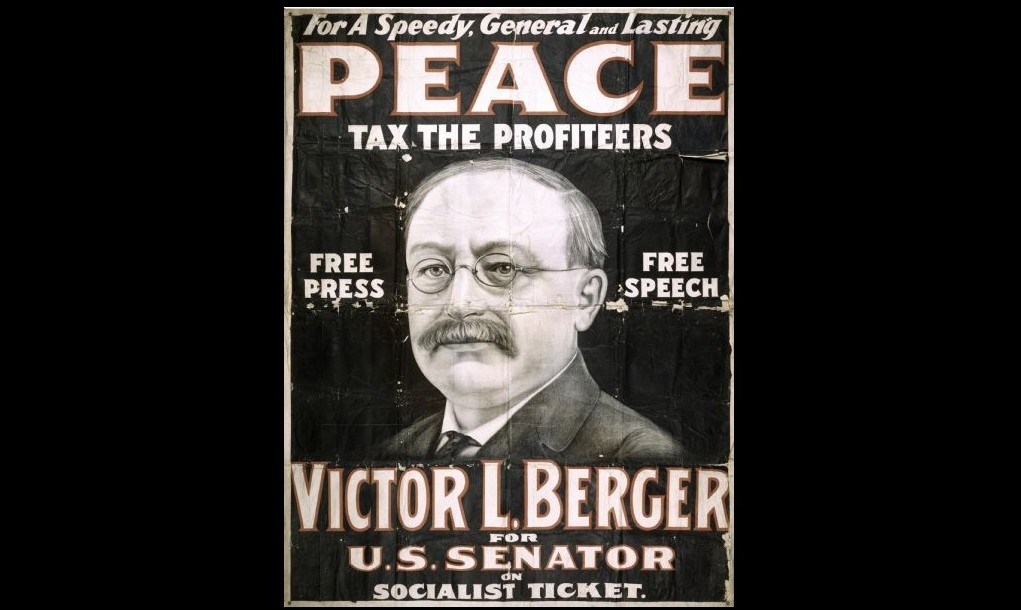
An critique from a partisan of a then formalizing Left Wing on the Socialist Party’s 1918 Congressional run led by candidates Victor Berger and Meyer London. The Socialist Party would win around 3.2% nationally (though running only in a minority of districts) in the elections of 1918, with Meyer London losing his New York City congressional seat but Victor Berger, who had done very well in a Senate special election earlier in the year. winning a House seat from Milwaukee. The limits of bourgeois democracy were made clear, and Berger, duly elected, was refused his seat on the basis of being a felon opposed to the war. A new election was called and Berger won again, leaving the seat open until a suitable victor won the 1920 election.
‘The Party Congressional Platform for 1918’ by Betram D. Wolfe from The New York Communist. Vol. 1 No. 6. May 24, 1919.
THE Left Wing holds it to be axiomatic that Socialists cannot be made except by teaching Socialism. All that most non-Socialists ever see of Socialist doctrine is that which is contained in our “Socialist” platform, official resumés of Socialist doctrine, and interpretations of current issues. It follows that upon the nature of our platform depends very largely the type of our converts. A revolutionary platform will not attract the bourgeoisie, and a petit-bourgeois platform will never attract the militant section of the working class.
Now the 1918 Congressional Platform of the American Socialist Party is the unadulterated work of its “theoreticians,” its “leaders,” unhampered by any suggestion from the rank and file. Written without a convention, adopted without a referendum, heralded by the Congressional candidates that ran on it for office, welcomed with fulsome praise by the petit-bourgeois organs, “The Nation,” “The Dial” and the “New Republic,” fathered and mothered in the People’s House under the direction of two bureaus of “Socialist” research–surely this must be a model platform for a Socialist party.
Before we examine its 57 planks, let us sum up the conditions out of which it grew and into which it was launched upon an expectant world. The platform is dated 1918. We may presume that it written in that year or the year previous. Internal evidence proves that it was written after the Russian revolutions had taken place, including the proletarian revolution. The program was launched in the midst of “a dying social order.” (p. 24.) The Capitalist system was tottering. In Russia, the proletariat had raised the standard of international revolution and called upon the workers of the world to unite around it. The war could only end in a relapse into barbarism or a world revolution. “Reconstruction” of the capitalist order was an impossibility.
And the 1918 platform? What else could it be but a summons to the proletariat to fulfill its historic mission? I have looked in vain through its 24 pages of 19-point type for a single mention of Socialism. The word does not occur once. The spirit of the class struggle–nay the very word “class struggle” is missing from its pages. Surplus value–not a suspicion of it. Historic materialism–the program never heard of any such doctrine. Historic materialism, class struggle, surplus value–are these not the three aspects the trinity, the union of which is the Socialist movement, its aim, its science, its tactics? What else is there to Socialism? What is there of Socialism in anything else?
Marx severely criticised the Gotha Program of 1875 because it erroneously declared that labor is the source of all wealth instead of saying the source of all value. He could not criticise the 1918 platform on that score, because it does not hint that labor is the source of anything.
STATE CAPITALISM.
The Russian revolution was proving, the Paris Commune had proved in practise, what Marx and Engels had taught in theory–that the Bourgeois State must be captured and destroyed, that the Proletarian State, the Dictatorship of the Proletariat must take its place–and that the proletarian state would die a natural death.
The 1918 Platform assumes the eternity of the State nay more, the eternity of the present, the bourgeois state. On the first page and in bold type, the 1918 Platform announces what it believes to be “the greatest of all issues with which the world stands faced the state is dominating industry. Who shall dominate the state? On the answer to this question depends the future of mankind.”
Engels has patiently explained that “the modern State, no matter what its form, is essentially a capitalist machine, the ideal personification of the total national capital.” Yet the 1918 Platform does not see the difference between State Capitalist and Socialist measures, between Wilson’s Parcel-Post banks and Lenin’s, between government ownership through bourgeois dictatorship and government ownership through the proletarian dictatorship. The first step in the Social Revolution is the seizure of the political power by the proletariat. The 1918 platform doesn’t mention the first step, but “demands” that the present State take over the railroads, mines, power, natural resources, large scale industries and the like. Says Engels: “The more it (the present State) proceeds to the taking over of productive forces, the more does it actually become the national capitalist, the more citizens does it exploit.” Engels merely says that the State “will have to” undertake the direction of industries, the 1918 platform “demands” that it do it. Surely, its authors are more revolutionary than Engels.
Space forbids an analysis of the “revolutionary” methods by which the Socialist party “demands” that the State take over industries. We can only note in passing that “this process shall be undertaken as speedily as is consistent with public order and security“; that the Socialist party “demands that the compensation, if any (we wonder why the doubt?), paid to the original owners is in no case to exceed the original cost of the physical property; and finally, we are so thoroughly bitten by the parliamentary bug of investigation commissions which publish reports, that when we come to the State ownership of electric power, our revolutionary program of expropriation culminates in a “demand” which must be quoted in full lest we miss some of the inspiration it contains:
“The Socialist Party demands immediate appointment of a Federal Power Commission with adequate representation of labor (Sammy Gompers take notice) to make an exhaustive (and no doubt exhausting) investigation into the subject, and to recommend legislation to Congress which will embody a comprehensive power development policy.”
REFORMS IN THE STRUCTURE OF GOVERNMENT.
When we come to the heading. “The Structure of Government,” we begin to pick up hope. “The present structure of government is totally inadequate to assume the additional burden of industrial control.” Perhaps we have been hasty in our judgment; perhaps the program warns that none of these things can be accomplished until the state has been revolutionized and the proletarian dictatorship established. Let us examine the measures proposed for the revolutionizing of the State. The system of checks and balances has destroyed efficiency, we complain. Then, in the interests of “democracy,” we select the most inefficient branch of the government–Congress–and demand that the other two branches be made responsible to it.
Not content with that, the program sets out to show Capitalism how to perfect bourgeois democracy. Here follow a startling series of “demands;” abolition of the Senate, democratization of Congressional procedure, direct election of the President and Vice-President, etc., etc., culminating in two super-revolutionary measures that will make Lenin look to his laurels, namely: “the terms of Congressmen to begin soon after election” and “self-government for the District of Columbia.”
As I write, out of the past comes an insistent echo of Marx’s thunderous denunciations of the Gotha platform: “But the platform applies neither to the latter (revolutionary dictatorship nor to the future organization of communist society.
“Its political demands contain nothing but the old democratic litany known to all the world, ‘universal suffrage,’ ‘direct legislation’ (for the district of Columbia?), ‘popular rights,’ ‘protection of the people,’ etc. They are a mere echo of the middle class Populist party.”
Next comes a section on “Civil Liberties”–utterly ridiculous if addressed to the present reactionary bourgeois State. The outstanding feature of this bourgeois bill of rights is a “demand” that “mob violence be suppressed through the power of the federal government.” A most dangerous demand to be made upon a reactionary government by a revolutionary party which depends upon mob violence (mass action) as a necessary weapon to overthrow the present State! Never fear, you needn’t demand that the government suppress mob violence! It surely will, and American Noskes rallying around these very slogans of the 1918 platform will lead the suppression.
TAXATION.
The next section deals with taxation. It contains a heartrending preamble to the effect that capitalism, poor capitalism, is tottering as a result of the “colossal war debt” and that (the Socialist party and the 1918 platform to the rescue!) we are going to show capitalism how to solve the problems of the public debt and the “ever menacing problem of wealth concentration.” (Which Marx foolishly thought inevitable under the present system–inevitable and the inevitable cause of the Revolution.) “To this end we favor”–for we are treading on bourgeois ground and therefore we no longer demand “an excess profits tax of approximately 100 per cent (a manifest impossibility under Capitalism); a progressive income tax; a progressive inheritance tax rising to 100% in large estates; taxation of “the unearned increment of land” (is there an earned increment?); “and a more adequate corporations tax.” I will forbear to inquire what the authors of this great document meant by “more adequate”; by “a comfortable and secure livelihood” which is not to be touched by the income tax or by “approximately 100%.” But I trust I will be pardoned if I quote the words of the now obviously antiquated Marx, who seemed to believe that: “Taxes are the foundation of the governmental machinery and of nothing else. An income tax presupposes the different sources of income of the different social classes, hence capitalist society.” Poor Marx seemed to think that taxation under Capitalism was no concern of the revolutionary proletariat. But since 1918 we know better!
Of course, modern finance is based on credit, and if that should break down, Heaven help us! the financial system might collapse; hence “our” program must needs concern itself with restoration of “our” shaky credit system, wherefore we elaborate a plan upon which I need not comment, except to note that we have succeeded in finding a scheme whereby, under Capitalism, we can eliminate entirely the necessity of maintaining a gold reserve! Isn’t that a splendid contribution to the saving of “civilization,” at a time when it is threatened by the over-capitalization of a pitifully inadequate gold supply!
Upon the Non-Partisan League platform, which has found its way into the 1918 program under the head of “Agriculture,” I shall not dwell, except to quote our revolutionary demands for “Public insurance against diseases of animals, diseases of plants, insect pests, hail, flood, drought, storm and fire;” and to delay any further analysis until we come to the general subject of sops and palliatives.
There is a chapter on “Conservation of Natural Resources” in which we “urge,”–in place of “demanding”–for we modestly feel that we are not experts in conservation as we are in high finance, and must therefore confine our services to mere advice. There is a chapter on Criminology which seems to be a combination of Enrico Ferri and August Claessens, with the caption, “Prisons.” There is a section on the Negro, which, peculiarly enough, demands “industrial citizenship” for the Negro (we vaguely wonder why the white wasn’t included). Why does the program want to give him “political citizenship,” and exactly what do our “leaders” mean by “educational citizenship” for the same oppressed Negro? If it is worth anything, we should like it too; if not, why “wish” it on the down-trodden black man?
We will not turn back to the one section which mentions the proletariat, entitled “Labor Legislation.” It is a compound of old Bismarckian formulae long ago introduced into Germany, such as minimum wage, unemployment insurance and the like–and this brings us to the subject of sops and palliatives in general.
I have used the familiar division of reforms into “sops” and “palliatives” because in these two words are implied the nature and purpose of two distinct kinds of “reforms.” “Palliatives” are reforms handed down by the bourgeoisie organized as the ruling class, to make industry more bearable in order that labor power may not thereby be impaired. Of such nature was the shortening of the working day to prevent the rapid deterioration of labor-power resulting from the long working day of the early capitalist epoch.
If a dog demands meat, and his demand becomes more and more insistent until he threatens to take it out of the calf of your leg, and you do not wish to give him meat, you may dip a piece of bread in gravy and throw him that–a “sop.”
As the working class becomes more and more conscious of its revolutionary aims, sops are thrown more and more frequently, to divert the workers from these same revolutionary aims. If the Socialist party, the most advanced section of the working class, turns aside for these sops when the goal is close at hand; if it goes further and issues a platform declaring that it is fighting for these sops, and neglects to mention anything but sops among its demands; if finally, it pretends to have won what capitalism has in self-defense handed down to it–it thereby diverts the working class from its class-conscious revolutionary aims, plays into the hands of capitalism, falling for sop and palliative alike, ceases to teach Socialism and make Socialists, and produces the 1918 Congressional Platform of the Socialist Party.
“INTERNATIONALISM” IN THE PLATFORM.
There remain two more things to consider: “International Reconstruction” and “Conclusion,” in which last we may perhaps expect to find a statement of Socialist principles.
The very title, “reconstruction,” is an index to the bourgeois character of the platform’s attitude. Capitalism is on the verge of collapse. In Russia a portion of the mighty edifice has been overthrown. The most truly advanced section of the working class in other countries is preparing to tear it down section by section till the whole edifice is destroyed. The revolutionary American proletariat, organized into the American Socialist Party, seeing Capitalism’s desperate straits, will help to stave off the collapse of “civilization,” will reconstruct the shaky structure, will keep alive the dying order.
And so the Platform demands a League of Nations. Of course, we call it a “Federation of Peoples,” and want an “adequate” (?) representation of labor. We are afraid that it will not have enough power to move against Russia, and hence we “demand legislative and administrative, as well as judicial functions.” We demand an international regulation of the hours of labor, thus giving the League an added pretext for interfering in labor disputes. We believe that under Capitalism peace and disarmament are possible, Marx and Engels to the contrary notwithstanding. We worry about a uniform monetary system (and, to phrase it inelegantly, we feel sure that that will “put the proletariat ten ahead”). We even discuss colonization and foreign investment, telling the League how to manage these two pesky matters, and then exhort the working classes of all nations to perceive “the necessity of seeking continually and aggressively (as in the present platform) to secure control of their respective governments to the end.” To what end? Why to the end that “these policies (the League, disarmament, the universal monetary system, etc.) be officially adopted by all the nations concerned.” Heaven forbid that they should “secure control of their respective governments” for any other purposes!
The Platform speaks of the “historic mission” of the Socialist Party of the United States to “prepare the workers of America to take part in the new fraternity of labor.” And I trust I will be pardoned for once more dragging in the antiquated Marx, who once said:
“And to what does the party reduce its internationalism? To the consciousness that the result of its efforts will be the ‘international fraternization of peoples”—a phrase borrowed from the bourgeois league of peace and freedom which is supposed to pass for the equivalent of the international fraternization of the working classes in their common struggle against the ruling classes and their governments.”
“CONCLUSION.”
And now for the two paragraphs headed “Conclusion.” Here we find the “theoretical” part of the program. It begins favorably. “We warn the masses (the first time we have noticed them) that the above program (twenty three pages of it) has reference to a dying social order.” We cheerfully announce that our “reconstruction” program is “designed to assist in the passing of this bankrupt system of capitalism…A complete transformation is necessary.” Anything short of this complete transformation will lead to another world tragedy (and of course that’s all we are aiming to avoid). But what complete transformation? Ah, here it is–next to the last sentence. “The main struggle of the masses is to secure control of these basic institutions (which?) and this requires an education of the people to the necessity of such control.”
But class consciousness? Why that’s all concentrated in the last sentence, which rhetoricians assure us is the most effective and emphatic place in a whole platform or essay. Here it is–note the class lines–
“In this work of education we invite the co-operation of all who recognize the opportunities for re-building the world on a basis of equity, democracy and fraternity for all.” Whatever that may mean.
The New York Communist began in April, 1919 as John Reed’s pioneering Communist paper published weekly by the city’s Left Wing Sections of the Socialist Party as different tendencies fought for position in the attempt to create a new, unified Communist Party. The paper began in a split in the Louis Fraina published Revolutionary Age. Edited by John Reed, with Eadmomn MacAlpine, Bertram Wolfe, Maximilian Cohen, until Reed resigned and left for Russia when Ben Gitlow took over. In June, 1921 it merged with Louis Fraina’s The Revolutionary Age after the expulsion of the Left Wing from the Socialist Party to form The Communist (one of many papers of the time with that name).
PDF of issue: https://www.marxists.org/history/usa/pubs/thecommunist/thecommunist1/v1n06-may-24-1919-NY-communist.pdf

