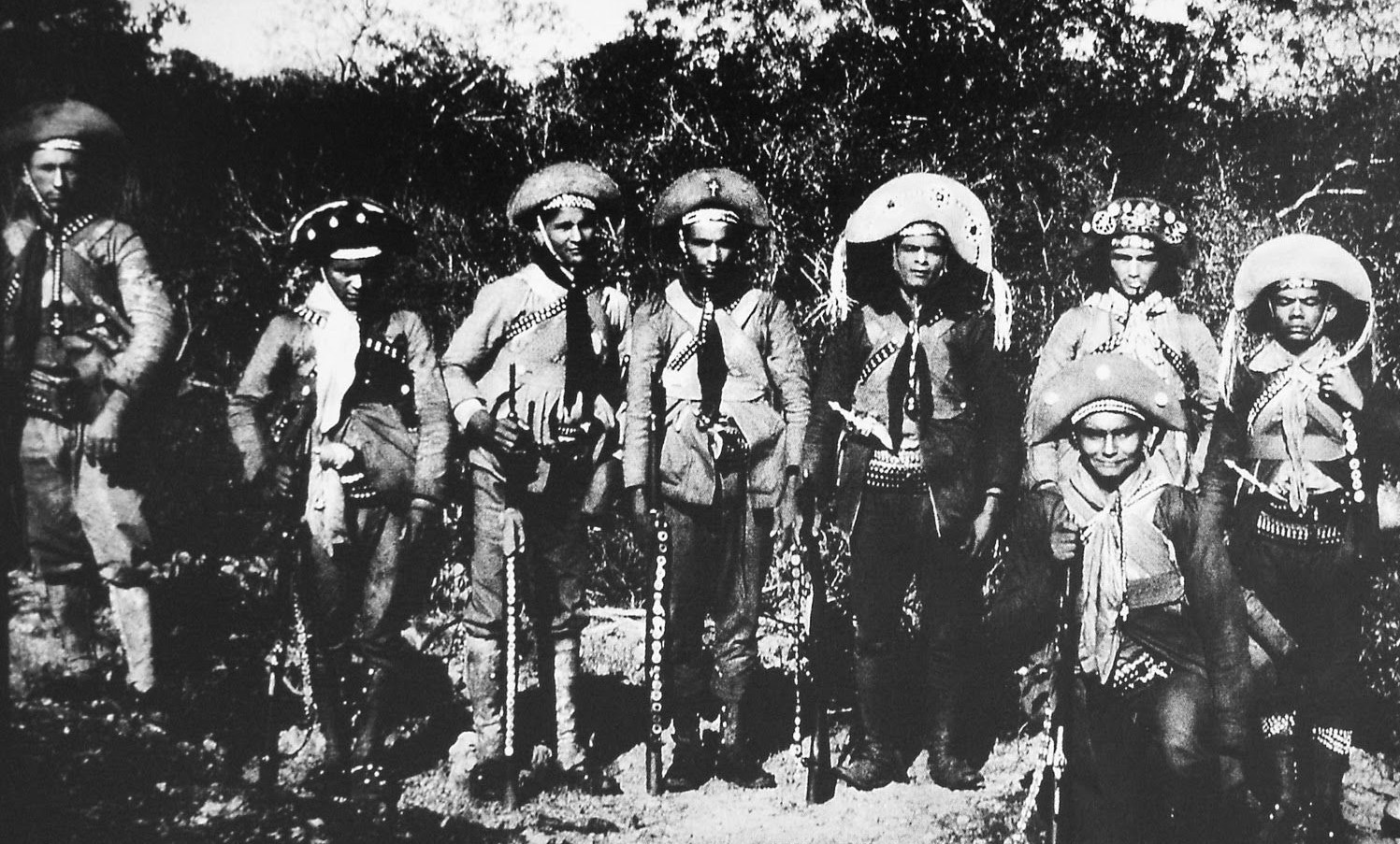
Luís Prestes on the ‘remnants of the slave and serf system’ and the phenomenon of the “Cangaceros.”
‘The Struggle of the Peasants in Brazil’ by L.C. Prestes from International Press Correspondence. Vol. 14 No. 24. April 20, 1934.
Brazil is one of those countries of Latin-America in which the remnants of feudalism are most plainly apparent. On the large feudal estates on the river Amazon, and in the provinces of Matto Grosso and Goyaz, on which the enslaved masses of Indians and Mestizos (Spanish or Portuguese half-caste) are starving, on the large Maté (tea) plantations in the South of Matto Grosso, and in the province of Parana there exist remnants of a slave and serf system, intermixed with new forms of capitalist wage labour.
In the so-called North-Eastern district, in which there are ten million inhabitants, mostly Indians, and in the coast district, where the population is mainly Negroes, there prevails a semi-feudal system. The country is divided into large latifundia, frequently belonging to one and the same family, which in this manner controls a vast territory of hundreds of thousands of square miles. Almost every large landowner is at the same time a colonel in the army and political leader to whom all the local authorities are subordinate. The peasants do not receive money wages, but only commodities from the stores of the large landowners. The permanent agrarian crisis in this district is the result of the decline in the sale of sugar and cotton, the main products of this district.
The misery prevailing in North-East Brazil has produced peculiar phenomena, such as religious mysticism and “Cangaco.” This mysticism has led to the gathering together of thousands of holy pilgrims. At the end of last century the government troops for many years conducted a regular warfare against these pilgrims and killed thousands of the followers of Antonio Conseilheiro in Canudos. Today “Padre Cicero” in Joazeiro is another such “holy pilgrim leader.” He has a big following among the peasant masses, whom he misuses for the interests of one clique of large landowners against the other. (Travora, the agricultural miner of the Vargas government, has the support of “Padre Cicero.”)
The “Cangaceros” are more or less numerous groups of peasants who are persecuted by the feudal lords or the government, and who conduct permanent guerilla warfare. One of their most famous leaders is “Lampeao,” who for more than a decade has waged a successful fight against all the armed forces sent out against him.
The present crisis in North-East Brazil, which has been intensified by the drought lasting already more than a year, has increased the number of “Cangaceros,” and today, in addition to “Lampeao,” there exist numerous leaders of small bands of peasants who live by confiscating the money and goods of the big landlords and rich merchants. The masses are greatly in sympathy with the “Cangaceros,” as the latter distribute a part of their spoils among them. This renders the struggle of the authorities against the “Cangaceros” very difficult, and the latter often attack the armed forces and seize their weapons and munitions.
Before the coup d’etat in the year 1930 the government of Brazil declared that the social question was a matter for the police, while the subsequent government of Vargas, Travora, José Americo at first attempted to rule by means of demagogic manœuvres. In 1933 the government sought by means of bribery to induce people to murder the leaders of the “Cangaceros.” This method was partly successful.
One of the most revolting cases of the brutality of the present government was the exhibition of the heads of three peasants and a peasant woman who had been arrested and afterwards beheaded by the government bands.
The government has now worked out a fresh plan of intensified struggle against the “Cangaceros.” The war ministry is being entrusted with the conduct of the campaign; the armed forces are being doubled, hand grenades and poison gas will be used. This new offensive is closely connected with the feverish preparation for fresh coup d’etat in Brazil and for war, which threatens to spread over the whole of Latin-America.
The Communist Party of Brazil, in spite of strict illegality, is overcoming the greatest obstacles placed in its way by the reaction, and exposing the class character of the slanderous campaign on the part of the bourgeois-junker press. Without idealising the movement of the “Cangaceros,” among whom there are often de-classed elements, alien to a really revolutionary movement, the Party is courageously coming forward in defence of the insurgent peasants and attempting to induce them to fight consciously for their class interests and to weld together the scattered movements into a large mass movement against feudalism and imperialism.
In order, however, to check the blind fury of the Brazilian big landowners against the militant peasant masses, the Communist Party of Brazil and the International Labour Defence are confronted with the urgent task of rousing the toilers of the whole world against the white terror which is raging in Brazil and for the immediate disarming of the police bands who are ravaging the interior of the country.
International Press Correspondence, widely known as”Inprecorr” was published by the Executive Committee of the Communist International (ECCI) regularly in German and English, occasionally in many other languages, beginning in 1921 and lasting in English until 1938. Inprecorr’s role was to supply translated articles to the English-speaking press of the International from the Comintern’s different sections, as well as news and statements from the ECCI. Many ‘Daily Worker’ and ‘Communist’ articles originated in Inprecorr, and it also published articles by American comrades for use in other countries. It was published at least weekly, and often thrice weekly. Inprecorr is an invaluable English-language source on the history of the Communist International and its sections.
PDF of issue: https://www.marxists.org/history/international/comintern/inprecor/1934/v14n24-apr-20-1934-Inprecor-op.pdf

