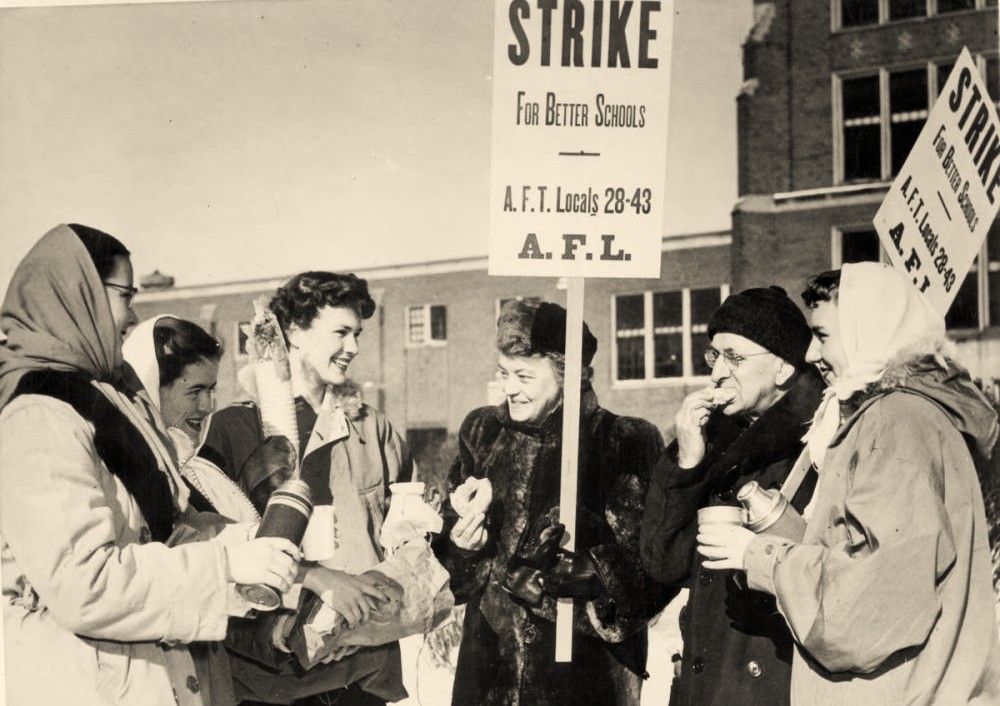
A report on the efforts of Socialist Party activists to get the A.F.T. to affirm its support for industrial unionism and affiliate with the Congress of Industrial Organizations at its 1937 convention. Their motion ultimately failing 285-227. The A.F.T. would remain in the A.F.L. until the 1955 rapprochement that created the A.F.L.-C.I.O.
‘The Teachers’ Convention Debates AFL-CIO Issue’ by Max Harway from Socialist Call. Vol. 3 No. 129. September 4, 1937.
MADISON, Wis. The main issue confronting the 21st Convention of the American Federation of Teachers at Madison was the problem of the CIO. At its 1933 Convention the Union had expressed its sympathy for the purposes of the CIO and condemned the action of the Executive Council in suspending the CIO union. Developments in the past year made it necessary to consider directly the question of CIO-affiliation.
Resolutions from the New York and Philadelphia locals urging immediate affiliation were countered by a campaign on the part of the powerful Chicago local in favor of the AFL. While the CIO forces did not press for their original program of immediate affiliation, they won several significant victories.
The question of affiliation was submitted to a referendum of the membership to be held at some time after February. Meanwhile however, the Convention reaffirmed its support of the principles and organizational work of the CIO, and went on record against paying the double per capita tax demanded by the AFL, as, a war cheat against the CIO. The resolution passed in regard to CIO affiliation reads as follows:
WHEREAS, the American Federation of Teachers stand for unity in the American labor movement; and
WHEREAS, a united labor movement is necessary for the continued success, both economically and politically, of the trade union movement in the United States; and
WHEREAS, at the 1936 convention the American Federation of Teachers went on record as being sympathetic to the sims and purposes of the Committee for Industrial Organization; and
WHEREAS, the American Federation of Teachers is on record as endorsing the principles of Industrial unionism; and
WHEREAS, the CIO, has achieved great organising campaigns; and WHEREAS, the Committee for Industrial Organization has influenced and aided both the unionization of teachers and the securing of progressive teacher legislation; and
WHEREAS, this convention of the American Federation of Teachers now has before it the question of the next step in its relation to the Committee for Industrial Organization, therefore,
BE IT RESOLVED: that the American Federation of Teachers reaffirms its endorsement of the principles of industrial unionism; and
BE IT FURTHER RESOLVED: that the American Federation Teachers at this twenty-first convention direct the Executive Council to undertake a referendum of the membership on the question” of affiliation of the American Federation of Teachers to the Committee for Industrial Organization; such referendum to be conducted in accordance with existing constitutional provisions at the discretion of the Executive Council; such referendum to be conducted no sooner than February 1st, 1938; and
BE IT FURTHER RESOLVED: that, preceding such referendum, the Executive Council be instructed to make an exhaustive study on (1) the structure, functioning, dues, contracts, autonomy, etc., of the CIO in its relation to labor; (2) the significance to the American Federation of Teachers of the proposed affiliation with the CIO, as concerns organizational campaigns, and national and local legislative campaigns, as well as the future position and program of the American Federation of Teachers in the Committee for Industrial Organisation, if affiliation is decided upon by the membership and that, the Executive Council be, instructed to send a written report of its findings to every member of the American Federation of Teachers; and
BE IT FURTHER RESOLVED: that the American Federation of Teachers protest the democratic action of the Executive Council of the American Federation of Labor in suspending unions affiliated to the Committee for Industrial Organization,
BE IT FURTHER RESOLVED: that the American Federation of Teachers refuse to pay the special per capita tax proposed by the Cincinnati conference of the American Federation of Labor; and
BE IT FINALLY RESOLVED: that for the purpose of unifying the American labor movement this Twenty-First Convention go on record as favoring the holding a national convention of all bonafide trade unions, AF of L, CIO, Railroad Brotherhoods, and genuine independent unions; and accordingly instruct our delegates to the 1937 convention of the American Federation of Labor to introduce such a resolution into that convention.
The resolution of the minority merely provided for the postponement of the entire issue until the next convention. The vote on the resolution was 285-227.
While no significant group in the AFT is opposed to the CIO on principle, there are besides the outright supporters of CIO affiliation, a large group loyal to the AFL primarily because of the liberal and the local central trades, and another group which prefers to wait until the CIO is somewhat stronger (or certain local problems have been solved) before affiliating.
It is mainly to placate this third group that the proposal for a referendum was substituted for the idea of immediate and outright affiliation.
Forces in the Convention
The three largest groups in the Convention center respectively around the Chicago local, the Ohio delegation, and the New York and Philadelphia delegations. There was also a large group of scattered locals owing allegiance to none of these major geographical groups. However, any proposal or candidates supported by two of these groups was sure of being carried.
On purely political issues there was very little disagreement, as the Communist Party position, influential in New York and Philadelphia differed in no respect from the position of the liberal and conservative elements dominating the other two large blocs on such questions as war and a farmer-labor party.
Save for the Socialists there was no opposition to the attempt to make the labor movement the tail to a rehabilitated Democratic Party, nor to complete reliance on collective security and sanctions as a preventive against war.
The Communist Party distinguished itself from other groups only in its determined drive for power. This was clearly shown not only in the elections but in its effort to keep the editorial board of the “American Teacher” susceptible to CP influence. So obvious were their maneuvers in this respect and so great was the resentment aroused that they were finally forced to consent to the reference of the whole matter to the Executive Council.
Results of the Elections.
In the contest for the presidency between Jerome Davis and Charles Stillman of Chicago, and in the vice-presidential contest in the Minnesota, Georgia and California areas the main issue was the CIO. In all these areas CIO supporters were elected by a wide margin, Professor Davis defeating Mr. Stillman by a vote of 321 to 153.
In the other two contests, involving the Massachusetts area and the vice-presidency for WPA and Adult Education, both candidates were sympathetic to the CIO and this issue was not involved.
The CP made a determined effort to limit the latter vice-presidency to a WPA teacher in order to secure the election of a candidate whom they could control. To do this they went to the extent of calling a special meeting of the Executive Council for the purpose of reversing a decision previously arrived at.
In this maneuver they alga failed and a Socialist, Joel Seidman, was elected. Other Socialists on the Executive Council are Charles J. Hendley of New York, John Connors of New Bedford, and Paul Preisler of St. Louis. Maynard Krueger, oldest member in point of service on the Executive Council, was barred from re-election by a combination of conservative forces which resented his role in blocking the suspension of the charter of the New York Local two years ago; and by Communists who felt his presence on the Executive Council a danger to the success of their maneuvers.
Within the last year the AFT has increased 46% in membership: This growth has occurred mainly in the New York, Philadelphia, and Chicago areas. The convention voted to raise a fund of $25,000 by a special assessment in the coming year for organizational work in selected areas through full-time paid organizers. The American Federation of Teachers can therefore look forward to an even more rapid increase in the coming year.
Socialist Call began as a weekly newspaper in New York in early 1935 by supporters of the Socialist Party’s Militant Faction Samuel DeWitt, Herbert Zam, Max Delson, Amicus Most, and Haim Kantorovitch, with others to rival the Old Guard’s ‘New Leader’. The Call Education Institute was also inaugurated as a rival to the right’s Rand School. In 1937, the Call as the Militant voice would fall victim to Party turmoil, becoming a paper of the Socialist Party leading bodies as it moved to Chicago in 1938, to Milwaukee in 1939, where it was renamed “The Call” and back to New York in 1940 where it eventually resumed the “Socialist Call” name and was published until 1954.
PDF of full issue: https://www.marxists.org/history/usa/pubs/socialist-call/call%203-129.pdf

