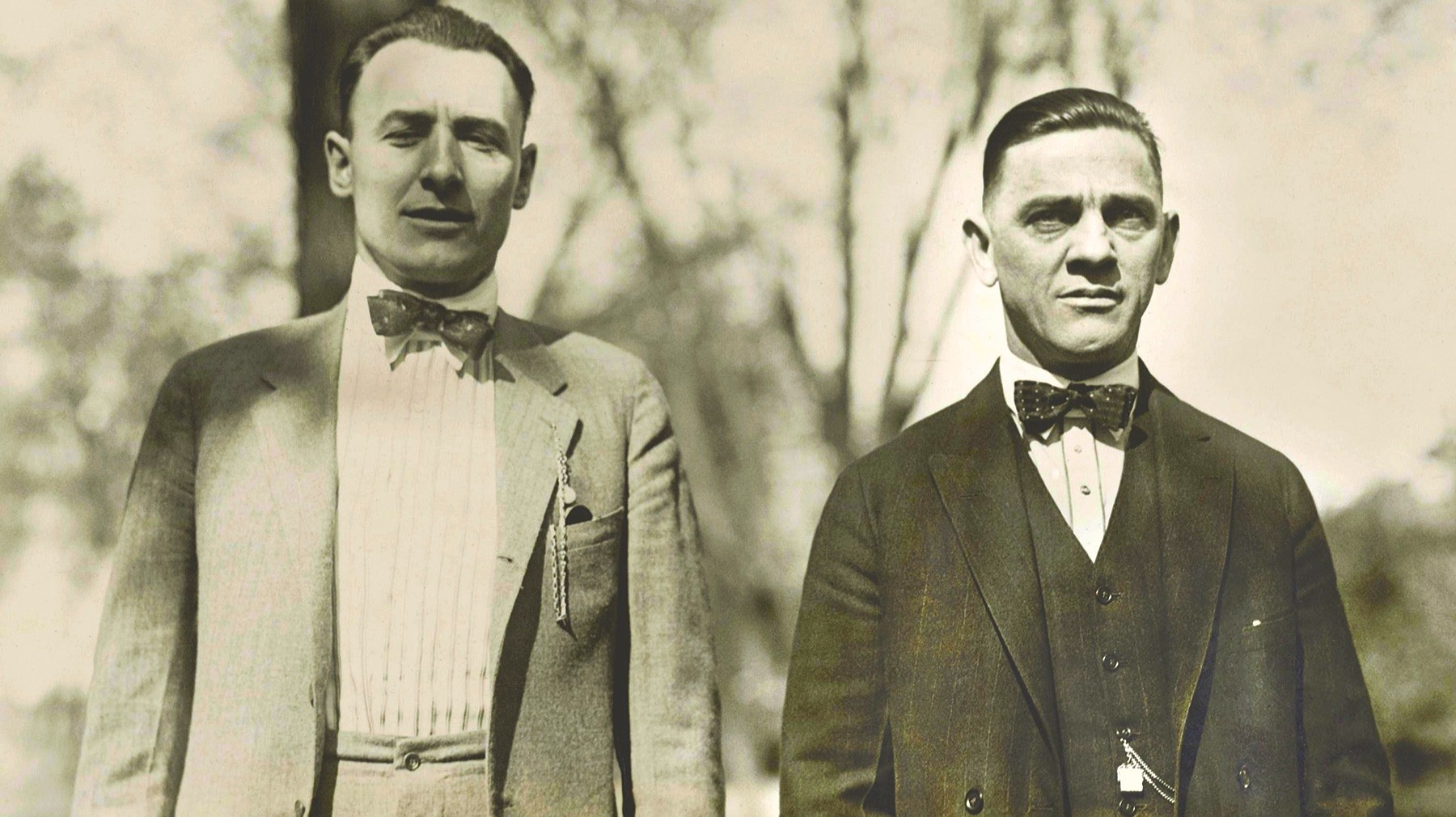
The immediate contexts for the ‘Battle of Blair Mountain,’ which saw mine union leaders Fred Mooney, Frank Keeney, and William H. Blizzard charged with attempting to overthrow the government, such as it was, of West Virginia.
‘West Virginia Mine Leaders on Trial for Insurrection’ by J. Charles Laue from Justice (I.L.G.W.U.). Vol. 3 No. 43. October 21, 1921.
The “War” as the West Virginia miners call the fighting between their forces and the mine guards from July 20 to Sept. 3 on the Boone-Logan county border (the coal operators and state officials prefer the term “Insurrection”) had all the reactions of a war of nations.
The hatred between the classes in so general that there is hardly a neutral person in the State and the miners, it must be acknowledged, also have many influential friends since they are all citizens and have a potential political strength. It was this observation after four days reconnoitering in the war zone that led Senator William K. Kenyon, chairman of the Senate investigating committee to remark: “There are no neutral witnesses in this state.” The public hearings when these are resumed at Washington within a few days will bear this out.
Every wild story was believed, each side made the most of the situation by circulating atrocity stories, both swear revenge for the injuries of the past and as soon as the first opportunity offers itself it is expected that the war will break out anew. In fact the coal operators are openly anxious for another test of arms. The army of Sheriff Don Chafin, of Logan, has extensive trenches on the Spruce ridge and this is the von Hindenburg line over which the operators say: “The union shall not pass.” The miners have secreted their best high powered rifles in the hollows and machine guns are hidden in the depths of some of the mines near the border, it is rumored.
So closely are the lines drawn in Mingo, McDowell, Boone and Kanawha counties that in all recent trials, with one exception, despite the jury law which permits the drawing of talesmen from other counties than that in which the indictment was brought, it is difficult to get an unbiased panel and the miners have frequently been able to get a disagreement in cases that seemed to be particularly unfavorable to them at the outset.
Only in Logan county where the list is drawn by Don Chafin, the uncrowned king of the Guyon, can a coal operators’ jury be obtained with certainty, willing to convict anyone that is suspected of having helped the mine workers. And even there in one case the jury was hung by a man who happened to have been a union sympathizer, without the sheriff’s agents having been aware of it.
The legal campaign of the coal operators now is to send away on long prison terms and possibly for life, C. Frank Keeney, president of District 17, United Mine Workers of America; Fred Mooney, secretary of the miners’ organization and W.H. Blizzard, said to have been the general of the miners forces that invaded Don Chafin’s country. They will thus have removed the ablest young leaders the miners have developed. Keeney and Mooney are already under indictment in Logan county charged with having fomented the “insurrection” and are therefore assumed to be responsible for all loss of life that occurred in the uprising.
They have already been in the Mingo county jail at Williamson for over a month held without ball on another indictment charging them with murder.
As indicated by the first testimony they presented to the Senate committee the operators propose to show that the United Mine Workers purchased rifles in lots of 1,500 to arm the 6,000 men that marched from Lens creek to Madison, a distance of over 50 miles with full commissary equipment and railroad rolling stock that union passes were used to give men safe conduct through the marching army, with the union seal affixed: that Red Cross and medical units were established and that food supplies were commandeered and payment guaranteed by the union.
Some general order supposed to have been issued from the district headquarters at Charleston was given which told the miners in four organized counties to march, and preparations were made providing for a court martial for maligners and cowards who refused to fight to free Mingo and in at least one instance a man was executed because he tried to desert before the battle of Blair, the operators claim.
The miners defense will rest upon the premise that the uprising was popular in nature and uncontrollable, was inspired by resentment at frequent murders committed by Baldwin-Felts agents in Mingo county, by gunmen authorized to act as deputy sheriffs by Don Chafin and by unwarranted attacks on the miners by militia and state police brought into the Ming fields under the martial law proclamation of the governor.
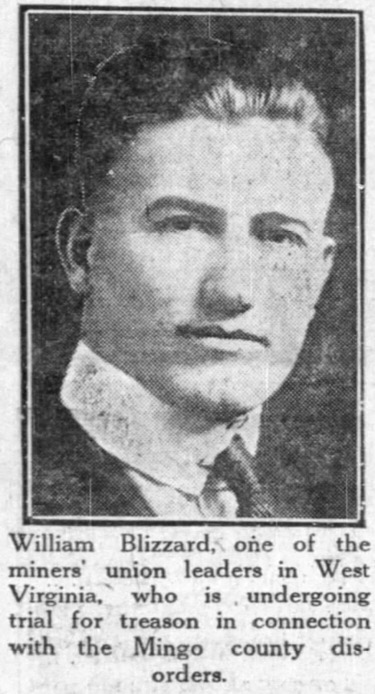
Most of the 500 Indictments obtained from the Logan county grand jury by the coal operators are against union miners who are supposed to have been members of the invading army and since entire locals joined, and in some instances penalties were inflicted by the unions on miners who would not fight to save the “Mingo strikers it was easy for the coal operators to get an indictment from their own jury against any union man whose name they might procure and this was simple since the union and non-union coal operators have the common bond that unites all employers. Practically all these indictments are based upon the killing of John Gore, a noted gunman of the Chafin army who was killed on Spruce ridge. Gore, by the way, is the only man the operators officially admit having lost.
A brief review of the guerilla warfare along a 25-mile front that culminated with the battle on Blair mountain at which casualties conservatively placed at about 20 dead and 50 wounded were reported makes clear the rapidity with which the miners army moved and the seriousness of the situation when federal troops arrived and disarmed the miners. The coal operators were panic-stricken for they saw coming a repetition of what had occurred in Russia when the masses lost faith in a czarist regime.
“The War” which lasted 13 days, began with an unsubstantiated report.
And the rumor started in this way. On August 12, a party of state militia men, young and untried boys, came tearing down the street in the town of Sharples and in riding down Main street one lad killed his horse by running into an automobile and was himself badly hurt.
His comrades proceeded to abuse the driver of the car, a miner, and asked him if he belonged to the union. When he said “Yes,” they cursed and threatened him and finally bragged of the numbers of miners they had killed in Mingo. This report gathered color as it was carried along until finally at Ottawa, Boone county men seized their arms, mustered 500 men in the first band and started the march gathering strength as they passed through the union districts until 6,000 men were under way and in about 10 days reached their objective at Madison to cross Logan and get into Mingo, only to disband on the advice of General H.H. Bandholts and the district officials. Federal troops had not yet arrived.
There would have been no battle at Blair at all if the Chafin forces had not taken advantage of Bandholtz’s turning back the main army of miners and sent Capt. J.R. Brockus, on August 27, with a squad of state police to serve warrants and arrest retreating miners. At Beech creek they wantonly killed three miners. Within two days a part of the miners’ army collected again and fighting began which resulted in the actual arrival of federal troops. This is the important point that will be made in the defense of the West Virginia strikers against the charge that they conspired to lead an insurrection.
One of the worst atrocity stories the coal operators circulated concerns “Sid” Hatfield whose memory is kept green by the mountaineers as a good citizen and fighting man. His grave across the river from Matewan, where Hatfield conducted a jewelry store and where the battle occurred in which seven Baldwin-Felts agents were killed and three miners were slain is next to that of Mayor Cabel Testerman who dropped at the first volley of the invading gunmen. It occupies a bluff on the Kentucky side overlooking the turbid waters of the Tug river and from it can be seen the miners tent colony at Blackberry City, W. Va. It is still unmarked by a tombstone, but anyone in the region will point out the yellow mound of sand under which the hero of Matewan lies. The funeral they will tell you was attended by everyone in the region and more than 2,000 persons came from the outside, Huntington, Charleston, Cabin creek, on foot, over the trails, by train and in automobiles over dangerous mountain roads to witness the burial.
It is said that after Hatfield shot Albert Felts he ground his heel into the face of the dead detective and that for this he was murdered when he came to Welch, seat of McDowell county to be arraigned on another indictment arising out of the Matewan battle after his first acquittal in Mingo.
But more reasonable was the version that old Tom Felts, head of the Baldwin-Felts Detective agency who directs its operations from Bluefields, swore to get revenge if the courts would not convict Hatfield and the others. He had reasons too, for in the Matewan battle he lost two brothers, Albert and Lee Felts, and the resulting clamor foretold the end of the mine guard system which he devised and out of which he got his living.
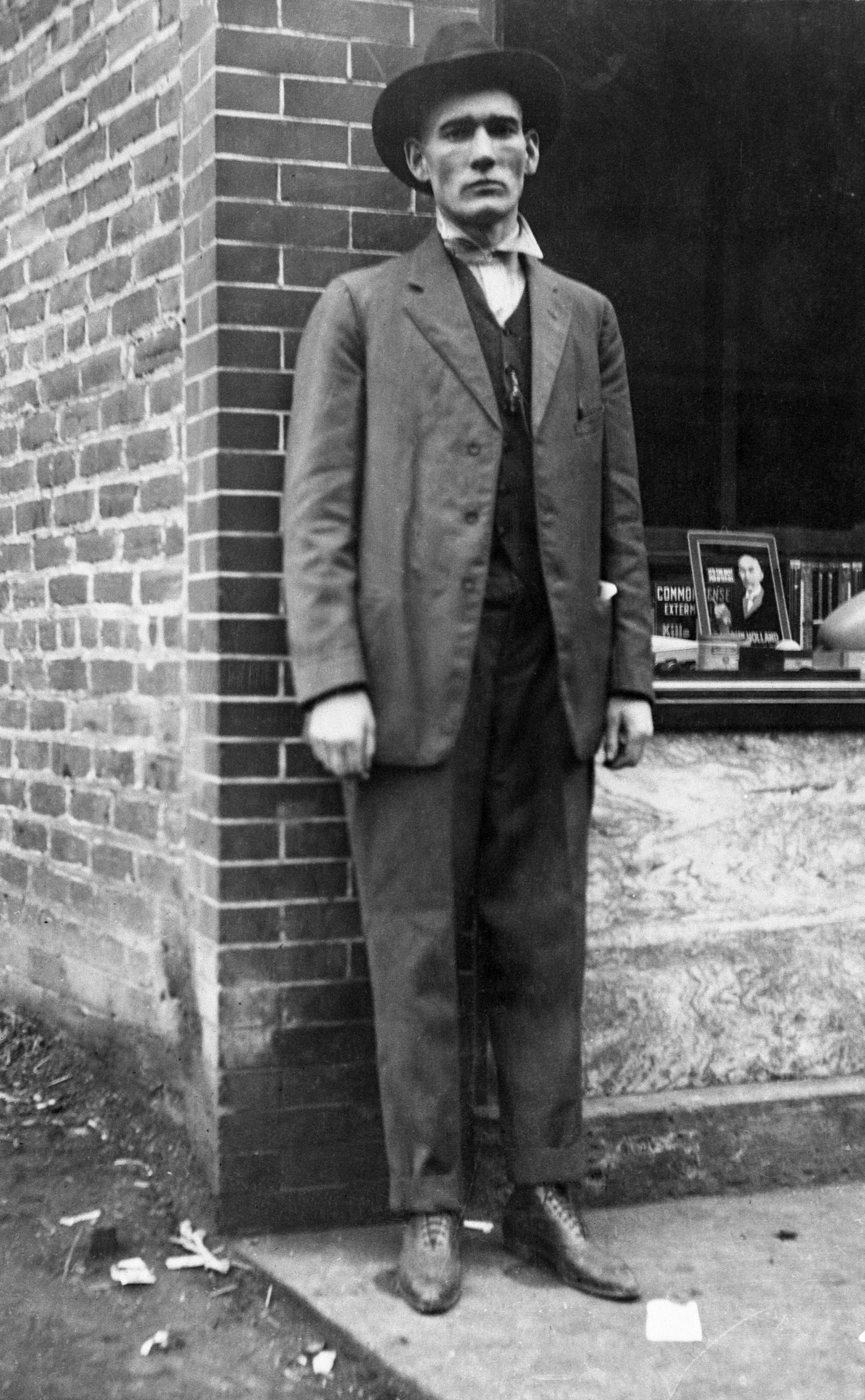
His agency had never been popular, the armored train that his men conducted through the Cabin creek and Paint creek fields in 1912 and the brutalities of his men at Ludlow, Colorado never having been forgotten.
Since Hatfield was killed, Tom Felts rarely leaves Bluefield and the same is said of C.E. Lively, the gunman who arranged the murder of Hatfield and Chambers Lively remains close to Don Chafin’s domain in Logan.
They tell a story about Lively that is generally believed by the miners who have no reason to love him, for he was both spy and traitor to them. “Ed” Chambers fell backwards in front of the court house at Welch, dead before he hit the steps from the volley of shots fired by the group of Baldwin-Felts agents waiting for the miners party to get into range. Lively then stepped forward, and to make sure that Chambers was done for, fired two more shots putting his pistol right back of the dead man’s ear. In court when being arraigned. Lively admitted that he killed Chambers, but he denied shooting Hatfield. Contrary to common report. Chambers is as much a hero in Mingo county as Hatfield. He was a member of an equally prominent and respectable family of first settlers and one of a group of young men who vied with each other in matters of personal courage and marksmanship. He was the leader among the miners of Matewan and it was his friendship with “Sid” that brought the best and quickest pistol shot to the miners side. Incidentally Hatfield was chief of police of Matewan; another miners’ sympathizer was the mayor and the sheriff of the county was also friendly. This was a hard combination for the Baldwin-Felts gang to tackle as it later turned out.
Back of all the recent trouble in West Virginia lies the deep-seated resentment of the workers against this brutal and unprovoked murder on the court house steps at Welch. This outrage made them lose faith in the government of West Virginia. That’s why a state of war with all the hatred of class antagonism still hovers over the mountain country.
The weekly newspaper of the International Ladies Garment Workers Union, Justice began in 1909 would sometimes be published in Yiddish, Spanish, Italian, and English, ran until 1995. As one of the most important unions in U.S. labor history, the paper is important. But as the I.L.G.W.U. also had a large left wing membership, and sometimes leadership, with nearly all the Socialist and Communist formations represented, the newspaper, especially in its earlier years, is also an important left paper with editors often coming straight from the ranks radical organizations. Given that the union had a large female membership, and was multi-lingual and multi-racial, the paper also addressed concerns not often raised in other parts of the labor movement, particularly in the American Federation of Labor.
PDF of full issue: https://www.marxists.org/history/usa/pubs/justice/1921/v03n43-oct-21-1921-justice.pdf

