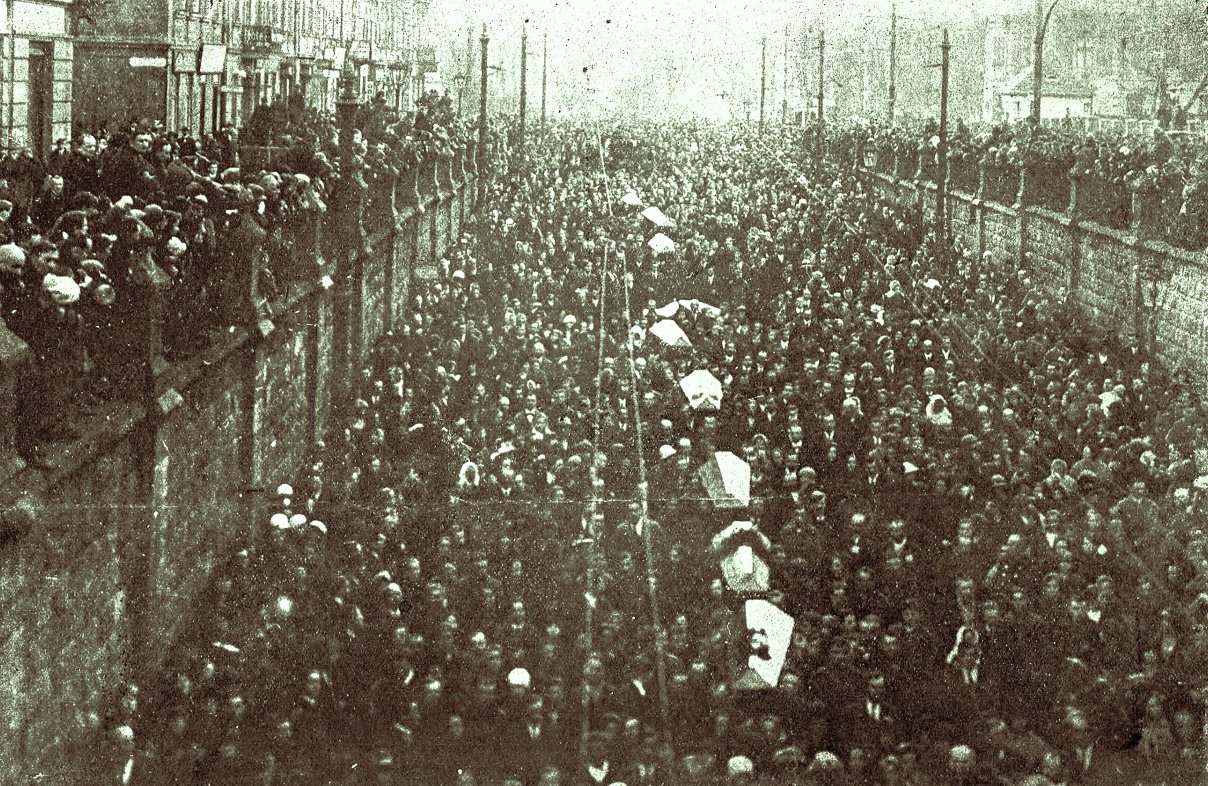
One of the great episodes in Poland’s class war was a series of strikes beginning in the summer of 1923 that culminated October’s general strikes and November’s uprising in Krakow. Because it happened simultaneously with the historic events in Germany and Bulgaria it did not then, or since, receive the attention it warranted. Below are seven articles of context and analysis from leading Communist activists as well as a Comintern statement from the time documented in the pages of Inprecorr.
‘The Revolt of the Polish Proletariat’ by Domski, Maciejevsky, Tokarski, Lada, and the E.C.C.I. from International Press Correspondence. July-December, 1923.
The Reactionary Government in Poland by L. Domski (Warsaw). July 5, 1923.
While in Hungary, in Italy, and now in Bulgaria, the Fascisti have only been able to seize power by means of violent upheavals, in Poland the can boast of having founded their power on a legal, parliamentary basis. The November elections of last year sealed the fate of Polish “democracy”. They annihilated the Centre groups of intellectuals supporting Pilsudsky, and made the Left dependent on the parties of the national majorities, who took their places in the new Sejm as the great rower.
Put from the very first day it was perfectly clear that the government of the Left and of the large landowning Centre, the Sikorsky Government, would not long be able to depend on the national minorities for support. For this our “democrats” are themselves too nationalist, and above all too anti-Semitic, and the moral Terror exercised by the Right, which declared Sikorsky’s Government a “Jewish Government” frightened the Left completely out of its senses. Thus the Sikorsky Government, in order to keep up appearances before the electors, was “obliged” to persecute the nationalist and Ukrainian separatists, with the result that, on May 26, it was overthrown in the Sejm, with the aid of the national minorities.
Timid democracy is now followed by no less timid reaction. The Witos Government, in which the Fascist elements predominate, is not much stronger from a parliamentary standpoint than the fallen Sikorsky Government li has to combine the interests of the large landowners with those of the peasantry, and it must not serve the interests of capital so well as to offend the “National Labor Party”. The consequence of this contradictory position is that, on the one hand, the junker elements of the Christian National Party do not participate directly in the Government led by the wily peasant Witos, but merely support it with reservations, while, on the other hand, one section of the Witos party has split off under the leadership of Dombski, and the National Labor Party is backing the Government very half-heartedly, as its leaders have to fight a powerful opposition in their own ranks, an opposition intensely hostile to any co-operation with the reaction. Thus the Witos Government has a very precarious foothold from a parliamentary point of view.
For the moment, the Right Government is therefore proceeding even more cautiously than the Left. The crafty Witos carefully avoided any definite program in his policy speech, and was as sparing of democratic promises as his “democratic” predecessor. At the same time he was much less anti-Semitic than General Sikorsky.
The nationalist members of the Cabinet have, up to the present, also taken care not to declare their attitude too openly. And the famous Dmovski, the strong man of national democracy, who has hitherto deliberately abstained from all political activity in subordinate positions, in order to be able to make his ministerial debut as prime minister, or at least as minister for foreign affairs, delivered such an exceedingly tame speech in Posen, where he was reminding the public of his existence, that even the Jewish press applauded his statesmanship.
Witos’ endeavors to retain the support of Pilsudski have also been very characteristic. Every attempt was made to prevent his resignation from the position of chief of the General Staff. But Pilsudski, like Dmovski, is much too ambitious to play second fiddle to anybody and he refused to act in the service of a Cabinet of his enemies. Witos, however, succeeded in inducing him to permit at least one of his faithful followers, General Szeptyck, to remain in the cabinet as Minister of War. Witos does not want to burn all his bridges.
It is clear that the ruling classes will not be prevented, by any amount of diplomacy, from utilizing their government in their own class interests. In Poland there are still far too many reminders of the revolutionary period, and these must be done away with by some means or other. A beginning has been made with the law protecting tenants. The Sejm is debating a new law providing that rents be raised, within a number of years, to pre-war level. These rents were exorbitant before the war, especially in Russian Poland, and swallowed up, on an average, one third of the income of the tenant. What will this signify today, when wages are far below pre-war level? Another gain achieved by the reaction is the law which limits the number of non-Polish students in the colleges. The amnesty law, which for the first time expressly excludes the communists from remission of sentences, also bears distinct traces of reactionary rule. Fascism unfolds its program but gradually; nevertheless, it is approaching its goal. And it need show the less diffidence in view of the fact that democracy, including the social patriots, is showing itself to be possessed of the usual amount of cowardice.
When Pilsudski declined to stand for President, he committed political suicide. His resignation from the position of Chief of Staff and his withdrawal from the army merely sealed his fate. The dauntless knight of “democracy” capitulated before reaction without the least show of resistance. He has fallen to rise no more.
To be sure, even the reactionaries are not showing much courage. The Fascist bomb outrages in Cracow, Warsaw, and Lodz, which preceded the constitution of the Witos Cabinet, bore witness to equal brutality and cowardice in their instigators. But, in the course of time, these assassins, finding that they go scot free, will gain more courage. There is nothing so encouraging as not being punished. Should Fascism ever feel that its adversaries are laying down their arms, then it will extend its attacks even to the corpse of parliamentarism. The Polish Mussolinis, who have hitherto imitated their Italian exemplars on paper only, will proceed to actual deeds. And if the Polish working class then begins the fight against Fascism, the social patriotic leaders will be conspicuous by their absence.
***
The Position of the Workers in Polish Upper Silesia by Maciejevsky (Warsaw). July 12, 1923.
During the strike in German Upper Silesia it was reported that our brothers on that side of the frontier, driven to despair at the conditions consequent on the daily increasing acuteness of the impending collapse of capitalist economics in Germany, have been throwing longing glances at Polish Upper Silesia. They have precious little cause for doing so! The following will make this clear.
It is possible that the real wages of the Polish Upper Silesian workers were, for a time, somewhat higher than those received by the miners of German Upper Silesia; but probably this is a mere passing phenomenon which will vanish as rapidly as it appeared.
As a matter of fact, after a comparatively long period of stabilization of prices, the Polish mark again sank tremendously at the end of April, and the beginning of May, and prices rose accordingly. The purchasing power of the wages received by the miners has decreased accordingly–it has decreased even further, for prices rise daily, whilst wages are paid out at longer intervals. As early as June 10 our Upper Silesian organ Pravda (Kattovitz) pointed out that, within a few weeks, provisions had risen in price by almost 30%; lard by even 50 %, sugar by 110%. The Upper Silesian commission for calculating the cost of living reckoned that the food expenses of a family had risen from 589,000 marks in April to 621,000 marks in May, that is, by 4%. Upon this the board of arbitration based its award, raising wages by 10% for the month of June, until July 1. Now, especially after the disastrous fall of the Polish mark during the last few days, and the equally disastrous rise in the price of food, I believe that our German Upper Silesian brothers will cease to cast longing glances over the frontier.
And this is not all! Capitalist exploitation in our part of Upper Silesia is not confined to a wage slavery equalling that which prevails on the other side of the border. Polish Upper Silesia, as is known, is entirely dependent on Germany for selling its coal. It can send but little of its coal to Poland, and exports 70% to Germany. If this export to Germany declines, the Polish Upper Silesian pitmen feel this promptly and acutely. And this is the case every time the comparative values of the German and Polish marks undergo a great alteration. If the Polish mark is high in value, then it is more advantageous for Germany to import the necessary coal from Great Britain and not from Polish Upper Silesia. This immediately affects the position of the Polish Upper Silesian workers. Another “advantage” possessed by the Polish Upper Silesians is that they are already beginning to feel the scourge of persecution against the communists, which in Poland is taking the form of proscription, deprivation of rights, and outlawry. “Communist putches” are concocted, on the approved pattern, and sham bomb attacks got up by police spies. In Cracow, even an attack on the Jews was laid at the door of the Upper Silesian communists! Thus we shall not have long to wait before we have an anti-communist law in Upper Silesia, framed according to the best Polish models.
***
The Revolt of the Proletariat in Poland by W. Lada (Berlin). August 2, 1923.
Once again the proletariat is giving the world’s rulers a painful surprise. The wages struggles in Poland have, according to a telegram received by the Vossische Zeitung, assumed a form which “calls for serious attention”. The textile workers’ strike has extended from Lodz over the whole of Poland: the factories have closed down at Bielystok, Biala-Bielsk, Zyrardov, Sochacezev, and Kalisz. The strike has developed a distinctly political character. There have been bloody collisions with the police. In Lodz and Czenstochau there have been killed and many wounded. According to information received from the official Polish telegraph agency, whose mendacity is proverbial, these bloody struggles were occasioned by the demonstrators, who threw stones at the police. This same report, as also the telegram of the Vossische Zeitung, asserts that the police were fired upon from the upper stories of the buildings, and that stones were thrown. The Vossische Zeitung even speaks of hand grenades! A general strike is said to have been proclaimed in Lodz. In Warsaw 14,000 metal workers are on strike. It may be seen that the government and the bourgeoisie are taking he movement very seriously, for a cabinet meeting was immediately convened to discuss the situation, and the big industrialists with their families fled from Lodz.
The fact that the movement has assumed such dimensions and such a character throws a bright light on the whole situation in Poland, and the situation in the whole capitalist world, for Poland belongs to the “victorious states”, and its rulers have long been accustomed to make eloquent speeches on the successful “reconstruction” and the “brilliant prospects for the future”. But lo and behold: suddenly the volcano of proletarian insurrection comes into eruption, and begins throwing up molten lava! And the lords of the situation take sudden alarm; they call upon the mounted police to come and help them, with guns and hand grenades, against their “fellow countrymen”! The inner enemy must be constantly watched and kept on the curb, otherwise all the magnificent prospects may vanish into thin air!
The fundamental causes of the movement are twofold. In the first place there are purely economic causes, and in the second place, those of a political character. The Polish textile industry, which urgently needs foreign markets for its normal activity, but has, since the war, lost these in Russia and the Far East, has been suffering since the end of the autumn of 1922 from the lack of markets. The crisis was particularly acute in spring, and was much aggravated by the general shortage of currency. A slight revival was observable during recent months, but there are no prospects of permanent improvement. The industrialists have resorted to the first means to hand, i.e., pressure on the workers. They refuse to raise wages, as previously agreed upon, in proportion to the increased cost of living, they will not grant their wage slaves their legal holidays and are provoking the workers in every possible manner.
Similar conditions have also prevailed for some weeks in the metal industry. The crisis under which Polish industry has been suffering for some months can be traced to the hopeless finances of the country. The attempt at salvation tried by the minister of finance Grabsky, who has since been thrown overboard, only had the effect of aggravating the situation: on June 18 the government found itself obliged to close the exchange for some time, a few months of “stabilization” ending in such a state of affairs on the exchange (dollar up to 180,000 marks!) that no other course remained. Since then, an energetic governmental action in support of the mark has raised it once more to 105,000 to 115,000 marks per dollar, but prices continue to rise uninterruptedly, and real wages to fall.
Further political reasons must be added to this. The present government, the Witcs-Glombinsky ministry, is in reality a disguised Fascist government. Not only is it prepared to adopt the sharpest measures against the revolutionary proletariat, not only does it meditate introducing capital punishment for the communists, but it is waging war on the reformists of the P.P.S., the Pilsudsky set, the bourgeois liberals. Under these circumstances, the social traitors from the P.P.S., who attempted under the Sikorsky government to divert the working class from the class struggle by every possible means, because they regarded this as “their” government (they were under Pilsudsky’s commands, in order to retain his influence in the army and administration), became angry, and no longer disdained to call upon the working class to defend its rights. Thus their deputies recently took part in the organization of a partial railwaymen’s strike in Galacia; they acted similarly with respect to the Galician agricultural laborers; and a short time ago the Warsaw trade union council, whose reformist majority is entirely under the influence of the P.P.S., resolved to start a comprehensive campaign and action for a general rise in wages, in which the general strike, as moved by the communists, was also held in view as a possibility. At the same time, the P.P.S. deputies supported the campaign by their motions in the Sejm for the fixing of wages in a new (theoretical) currency, the Zloty (1 zloty=1 gold franc). Everything which the P.P.S. had found just and excusable under the Sikorsky government now furnished ample material for agitation. The fact that the P.P.S., actuated by narrow party considerations, no longer put forth such great endeavors to hinder and crush class warfare, naturally contributed greatly to the rise of indignation against the government among the working masses, who in any case were not greatly in favor of the Fascist parties the national and Christian democrats.
It is worthy of remark that, according to the report of the Vossische Zeitung, the strike is completely or substantially under communist leadership; the leadership has been torn from the hands of the trade unions, and “inflammatory communist speeches” have been held in Lodz and Czenstochau. This proves once more that the communists, despite all obstacles laid in their path by the rulers, are still able to seize the leadership of the working masses, as soon as these masses are set in motion, and are borne along the current of the class war.
Another instructive fact is that as recently as 10 days ago, the feeling among the working masses was judged by a meeting convened by the Warsaw trade union council to be little favorable to the movement. But now we receive reports from Warsaw that it was resolved, at the last session of the central council of the trade unions, to make arrangements for a general strike. As already mentioned, one part of the metal workers has already gone on strike. This gives the lie to the continually repeated assertions made by the reformists, that it is impossible to undertake any fight against reaction, because the working masses are “asleep”.
Another point must be emphasized here. There is every reason to suspect that the government has by the aid of its agent provocateurs endeavored to impart to the movement such a character as will furnish a pretext for having recourse to armed forces in the course of the struggle, in order to be able to follow this up by an era of sharpest repressions against the labor movement as a whole, and against the communists in particular. It is a fact that the two leading bourgeois newspapers of Warsaw, Gazeta Warszawska (national democratic) and Rzcezposplita (Christian conservative agrarian), reported about a week ago that the communists were alleged to be displaying great activity. Naturally this activity was associated with the intrigues practised by the “Jews” and “Germans’. The Piast, the organ of the peasants’ party (party of the prime minister Witos), issued “warnings” against the comprehensive “seditious” activity going on in the open country. And even now the Gazeta Warszawska writes about a “general strike attack against Poland”, being carried on in two directions: Berlin proceeding against Poland, through the agency of Jewish speculators, whilst its socialists and communists seek to undermine the foundations of the Polish state in a social direction”. The difficult position into which the Witos-Glombinsky government has been brought by the financial and economic crisis renders a “communist putsch” necessary to it, precisely like the Cuno-Braun government, to enable it to drown the movement in blood, and thus to more easily present themselves to bourgeois society in the role of saviours of this society, and to assume full dictatorial powers The Fascisti are the same in every country!
***
The Strike Wave in Poland by P. Tokarski. October 11, 1923.
After one and, a half year’s silence on the industrial field, a number of wages strikes broke out at the beginning of this year, ending for the most part in the defeat of the workers, and it became quite evident that Poland would presently be the scene of strikes carried on with double energy and intensity. And indeed we had not to wait very long. The summer, especially the month of July, was filled with economic struggles, equalling in extent, obstinacy, and intensity those of the year 1920 and the first half of 1921.
The causes of this rising tide of strikes were, for the most part, to be traced to the extraordinary worsening of the economic position of the workers, and in the reduction of their real wages. At the beginning of the year the average real working wage amounted to 30 to 40 per cent of pre-war wages, while in 1921 the proportion was still 50%. The comparison is best made between the prices of food and wages. In Warsaw the prices for the most important articles of food rose during the month of June from 2900 Polish marks for a loaf of bread to 5250 Polish marks, sugar from 6500 to 15,000 Polish marks, milk from 900 to 2100 etc. As a general rule food prices rose by 100 % and more, while the Statistical Office calculated the rise in the cost of maintenance of a worker’s family during this period at only 49.99%. The workers in the provinces have always been, and still are, in the most wretched position; in July their daily wages frequently did not suffice to purchase a loaf of bread.
The general political conditions have also greatly contributed to swelling the wave of strikes. The new nationalist Right government, which promoted the export of the most important foodstuffs to foreign countries, unquestionably supported the speculation in high prices and profiteering in the country, persecuted the labor movement, and dispersed the radical workers’ trade unions, afforded no hopes of a peaceful settlement of wages and working conditions through the labor inspectors. Every worker, no matter what political tendency, has felt and perceived that if he desires a better lot he will have to fight lor it. The influence of the events and the growth of the revolutionary movement in Germany has also been very great.
The fermentation began as early as June. The miserably paid workers of the East Galician saw mills were the first to strike. But the actual strike movement did not begin until July, immediately after the publication by the Statistical Office of the index figures with its unfair reduction. In almost all industries the following demands were made: a general addition of 100 % to the June wages (textile workers only 70 %), the reckoning of wages in the “Zlity polski” (a newly introduced currency, corresponding approximately to the Swiss franc), publication of the index figure, settlement of rate of wages every two weeks, and finally, for Warsaw, an amount equal to 50% of the June wages to be paid as compensation for the insufficient wages received in June. The communists’ demand for a stable wage has been extremely popular. The strike tactics followed have avoided any demonstration or solidarity strikes and the attempt has rather been made to unite the strike movements of separate groups, crafts, and factories. Thus in Warsaw it was possible to coordinate and combine the strikes by the general demand of a 50 % addition to the June wages.
The strike movement exceeded all expectations. In the middle of July, almost the whole proletariat of Poland went simultaneously on strike. The sole exception were the miners, whose demands were at once granted by the employers at the beginning of the month, without resistance or long negotiations. The strike among the textile workers attained the greatest extent and the greatest intensity. All the factories in the Lodz district were involved in the strike, the leather factories and spinning mills in Czenstochau, a huge undertaking, employing over 8000 workers, in Zyrardow (near Warsaw), the spinning mill “Wola” at Warsaw, the textile factories in Zawiercie, Bialystok, and Teschen Silesia–over 100,000 workers in all. In the metal industry the struggles of the Warsaw metal workers were of the greatest importance, these comprising over 70 metal working concerns with 20,000 workers. Next in importance were the strikes in the great metal factories in Ostrowietz and Strachowitze, etc. In the building industry 15,000 workers went on strike in Warsaw, and work was also stopped on buildings in Lublin, Lodz, and Czenstochas. In the wood industry, not only the above mentioned saw mills in East Galacia were laid idle, but also the whole of the veneering and cabinet making factories in Warsaw and Noworadomsk.
In point of fact the leadership of the strike movement was in the hands of the red fractions, although the struggle was headed by the trade unions. In Warsaw, at the sessions held by the trade union council and at the mass meetings, when the strike movement was discussed, it was invariably the resolutions moved by the “Reds” which were passed, and these were regarded as the actual champions and leaders of the movement. In Lodz, the majority v ne strike leaders were “red”. The reformist committees felt it to be impossible to hold up the struggle, but were afraid to undertake its leadership, and hindered its breaking out. The greater part of the conflicts began without the agreement of the trade unions, and it was not until later that the leading trade unionists took up the struggle and commenced to “lead” it.
The metal workers strike in Warsaw was of a most determined and obstinate character. The government mobilized the soldiery and police for the protection of the employers The metal factories at Ostrow and Starachowitze were occupied by the military, in Bielsk the workers who had been arrested were maltreated, in Lodz and Czenstochau a peaceful demonstration of the textile workers was dispersed by rifle fire. Many were left lying dead or wounded in the streets. As a reply to this treatment of their demonstration, and to the volleys fired into the ranks of the workers, the workers got up even mightier demonstrations and great mass meetings. In Warsaw the number of those attending the mass meetings exceeded that of the year 1919. The protest demonstrations against the persecutions by the government were especially effective in Czenstochau. A one day’s strike was proclaimed as a protest against the massacre in the workers’ demonstration. In this town, a perfect nest of the priesthood, everything was brought to a perfect standstill. When all the delegates in the factories were afterwards arrested, a fresh strike broke out spontaneously, and the workers did not resume work until the released delegates appeared personally in the factories again.
The solidarity of the workers, the fighting spirit of the masses, bore fruit: The majority of the strikes ended victoriously. In Lodz the textile workers received a 67% rise in place of the 79% demanded, and they would have obtained all their demands had the trade union leaders not acceded too promptly to the terms offered. In Warsaw the greater part of the demands put forward by the metal workers were granted, and what is of still greater importance, it was decided to conclude a collective agreement every three months, a point on which the metal workers’ union had been struggling for 2 1/2 years. Here and there the workers succeeded in having the index figure calculated every two weeks and the wages adapted correspondingly. The results of the struggle have not been so good in the building and timber trades.
But the moral and general political results of this strike movement have been even greater than the material ones. The workers have been shaken out of the state of passivity in which they had long been sunk, and have found the strength to fight to a victory. At last the influence of the “Reds”–the communists–has become powerful among the masses. The communists have not fought for aims incomprehensible to the masses, but have stood for another piece of bread, for a better life for the working people. During these actions the working class has been able to realize that the communist, the “Red is fighting for the proletariat, and knows how to fight.” The estrangement of the masses from the conscious communist workers has vanished at last. One proof of the growth of the influence of the communists on the masses after the strike action is the victory won at the election to the textile workers congress at Lodz: not a single socialist was elected out of 20 delegates, but only members of the opposition.
The latest economic strikes have helped to break down the apathy hitherto shown by the working masses in Poland. The moment is approaching when the working masses will not merely fight for a morsel of bread, but for their complete social emancipation.
***
The Situation in Poland by Macieyevski. November 22, 1923.
The mighty uprising of the working class, beginning in the last week of October, has thrown a sudden flashlight on the situation in Poland. Poland too is living over a volcano. The elements of this unstable equilibrium are manifold.
They must be sought in the spheres of home and foreign politics alike.
The destructive elements of a foreign political nature arise from two facts: in the first place from the political, military, and economic-financial dependence of Poland on the Entente–above all on France–and in the second place from Poland’s special position between two stools: Soviet Russia on one side and revolutionary Germany on the other.
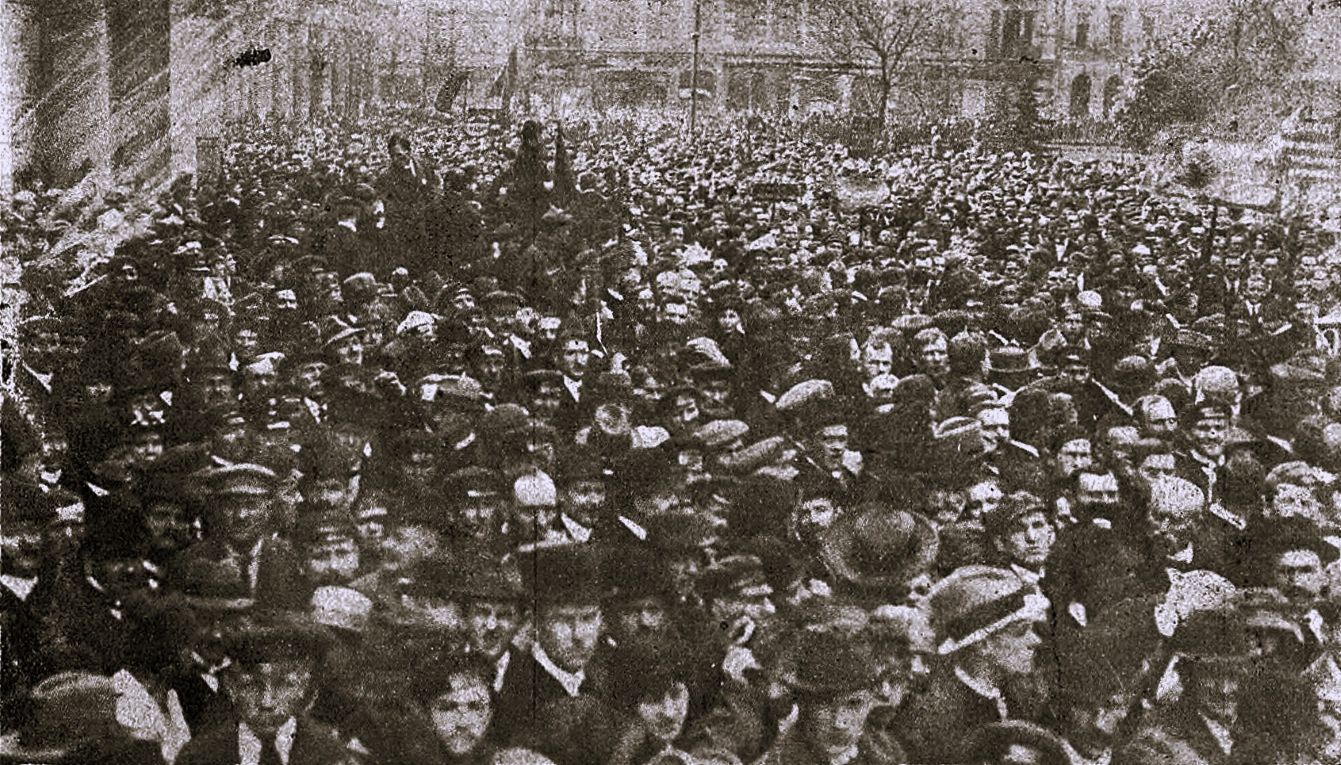
Never before has the dependence of “independent Poland” on the Allies, and especially on France, been so clearly evident as during the last few weeks–on the eve of the sixth year of independence. Now that the Ruhr occupation has torn a rent in the status quo established by the Versailles Peace, Poland’s foreign policy is completely dominated by the endeavor to draw the knots tighter which bind Poland to the Allies, that this status may not be altered, but where possible further developed and promoted (in the spirit and on the lines of the old imperialist desires of France and Poland in the years 1918/1919). Tangible evidence of this may be found in the latest negotiations with the member of the Finance Committee of the French Senate, M. Henry Berenger, in reference to a loan to be employed for military purposes, to the organization of a centre for the military training of Polish generals under the guidance of the French military authorities, and further to the delegation of two of the highest military authorities of Poland–its former Minister of War and its former Chief of the General staff–Generals Sikorski and Sosnkovski, to France for military purposes. And if we further recollect the delegation of a financial “adviser” to Poland by England, and the role played by this power in Polish-Danzig relations, as also the latest negotiations conducted by the Polish Minister of Finance, Kucharski, in London, with reference to the floating of a loan, the dependence of Poland upon England becomes sufficiently evident.
Poland’s position between Soviet Russia and the revolutionary ferment in Germany determines in advance the policy of its leading bourgeois circles. The Rzeczspolita (Republic), a paper which excellently reflects the opinions prevailing in the ruling class, contained an article by the chief editor in its issue of October 29, in which the latest changes in the Cabinet were justified:
“The forthcoming period of the next few months will be decisive…Now, at the moment when the whole of Central and Eastern Europe is put out joint by the upheavals in Germany and the presumed readiness of the Soviets when the transformations in Germany are throwing open the gates for a now configuration of conditions in the whole of Europe, it is necessary to exert our powers of political pressure in the sphere of international politics”.
This declaration on the part of a leader of one of the four parties of the right, forming the Government Bloc expresses plainly enough what role bourgeois Poland expects to play in the coming great revolutionary upheavals in Central and Eastern Europe. It chooses the role of the outermost rampart of capitalist “order” towards the East, the role of the furthest outpost of the gendarmerie watching over the “peace” of Europe at the present day-France. The interest evinced by Poland in the latest speeches of Comrade Trotzky. concerning the German Revolution is evidence of the fact that bourgeois Poland is by no means inclined to play the part of a “bridge”; it is anxious to play an active part in the coming struggle, and this is scarcely compatible with the rôle of a “bridge”.
The internal political difficulties at present being experienced by Poland are no less acute than the foreign political ones.
Formally regarded, the trouble here is a result of financial insolvency. This generates rises in prices, and thought these have not increased to an extent comparable with German conditions, still the rise is enormous; it also causes an industrial crisis, a gaping disparity between the wages and salaries of the broad working masses and the prices of all articles of daily consumption. The rising prices are thus a powerful revolutionizing factor. The financial insolvency deprives the State of any possibility of satisfying the demands of its workers without, going from bad to worse in this respect. The financial insolvency is one of the most important causes of the industrial crisis in the country, which has otherwise the advantages of possessing important industrial materials, good labor power, and an average quantity and quality of technical means of production. The latest social crisis is therefore partly to be sought in this insolvency.
But even so we have not reached the rock-bottom of things. Considering the raw natural wealth of Poland, and its relatively advantageous foreign political position–compared with Germany–its pecuniary embarrassment is somewhat difficult to understand. Here a differentiation must be made between two things: in the first place, the present attitude of strained militarist-imperialist attention of the Polish State and, in the second place, the struggle which has been going on uninterruptedly for years between the two great classes of bourgeois Poland, the industrial and agrarian bourgeoisie and the rural petty bourgeoisie. This struggle continues obstinately, and is concerned with the question as to which of the classes is to enjoy all the advantages offered by the state, and which is to bear all the burdens. As neither of the two parties want to bear the burdens, recourse has been made to the means adopted by all bankrupt states during the present transitional period: the great masses of the workers are robbed by means of the inflation swindle: And though Poland has no Stinnes as yet, still it may be seen that the great financial and industrial magnates, are making gigantic profits by means of the same system of inflation, which is ruining workers, clerks, officials, middle class and petty bourgeoisie. Just a few days ago a representative of the peasantry pointed out, in the Senate, that one of the causes of the unprecedented conditions in Poland is the credit policy pursued by all Polish governments with reference to the banks. At New Year–so the speaker said–the sum granted to the banks as credit from the government amounted to 180 milliards of marks (at the then rate of exchange ten million dollars). At the present time the value of this loan amounts to 120,000 dollars at most. In this manner the state has lost 9,880,000 dollars–more than the value of the whole of the paper money in circulation. The banks are paying 1 to 3% interest on this loan, and receive, 15 to 18% “officially”, but “unofficially” a great deal more. The profits of the banks for 10 months may be estimated to be at least 300 milliard Polish marks.
This small example serves to show that as a matter of fact the social background of Polish financial embarrassment is the same as has brought about Germany’s financial position: big capital is making use of the state to extract the utmost possible amount of “substance” from the productive categories of workers, whilst the state itself is gradually rendered destitute of all the means which it requires for its normal functions.
But the internal political difficulties are by no means confined to the financial, economic, and social convulsions. Poland, created under the slogan of the right of self-determination of nations, bears within itself the canker of national conflicts. In order that we may gain an idea of this side of Poland’s inner life, we must accord consideration to two facts in their relation to recent occurrences.
At the present time the law courts of the Polish bourgeois Republic are demanding that 25 deputies be delivered over to “justice”. Among these deputies are 16 Ukrainians. This justifies a liberal Polish political economist–who, by the way, is a former Czarist general and Russian cadet!–in making the assertion that Polish “justice” is thus pursuing the purpose of annihilating the representation of a whole nationality. There is the less doubt about the truth of this in view of the fact that the ruling Polish party–the National Democrats–has invariably held it to be one of its most important tasks to exterminate the “non-existent” Ukrainian nationality. A second example: A short time ago, the President of the Republic, M. Voyciechowski, travelled through the border districts of “his” realm. In the course of this journey he visited the old Lithuanian town of Grodno, On this occasion a decree was issued this was established as a fact a few days ago in the Senate by a representative of the radical peasants’ party–to the effect that neither windows nor balconies were permitted to be opened in the streets through which “his majesty” passed. “Thus travelled Nicolaus II”, was the ironical comment of the oppositional senator. But for the full realization of the piquancy of the situation it is necessary to know that M. Voyciechowski, who is doing his best to promote reaction in Poland at the present time, was for many years a leader of the Polish Social Democratic Party, and until 1905 smuggled whole hundredweights of revolutionary literature against Nicolas into Poland on his own back! But to regard the matter from its serious side, mention must be made of a rumour, though this is not vet confirmed, that two divisions of troops stationed on the Russian frontier have “emigrated” to Russia! It may easily be imagined the perils bourgeois Poland feels at its own flanks “in view of the revolutionary convulsions in Germany, and the presumed readiness of Soviet Russia”!
This is a broad outline of the circumstances which have led to the changes in the Polish Government, two National Democratic Ministers being replaced by two others leaders of the second rank (Seyda and Glombinski) being substituted in the Cabinet by the actual leaders of the party, Dmovski and Grabski. Other changes are the appointment to the position of vice-president of Voyciech Korfanty, who as the leader of “Christian Democracy” shares Dmovsky’s notoriety as an “eater” of Germans and a zealous agent of French big capital. The basis of the Cabinet has also been further “extended” by the substitution of a representative of “Christian Agrarianism”, the sugar magnate Chlapovski, in the Ministry of Agriculture, in place of a National Democrat (this party is to receive another portfolio in place of this). This is not only for the purpose of “extending” the basis of the Cabinet, but also of increasing its power and “competence”. In other words: bourgeois Poland is to stand ready to give battle to the hereditary enemy at home and abroad as soon as the hour strikes.
***
To the Workers of All Countries! November 22, 1923.
The recent big strikes in all parts of Poland, the strikes of the miners, the textile workers, the railwaymen, the postal servants, the general strike in Upper Silesia, in Galicia and Warsaw, and finally the bloody struggles in Cracow, Tarnov, Borislav, draw the attention of the international proletariat to the Polish Section of the proletarian fighting front.
These events go to prove that the Polish working class is no longer passive, that it has the will to oppose the capitalist offensive, and that the capitalists can nowhere succeed in making obedient slaves of the workers. Thus the German workers can see that they do not stand alone in their difficult struggle, that their Polish brothers are also engaged in a struggle with their own reaction and will not tolerate an intervention of their government in the German revolution.
The proletarian revolution of Germany has certainly influenced the workers’ struggles in Poland. What an impetus must have been and has been given to the movement of the exploited in all countries by the revolutionary struggle of the German proletariat! The alternative before it is: revolution or slavery and barbarism.
In the recent struggles of the Polish working class all the problems of the Polish revolution suddenly became evident, and the way in which the Polish proletariat must follow its struggle has become clear.
The savage terror of the Dmovsky-Korfanty government, the militarisation of the railwaymen, the field courts martial against strikers, all this has shown what crimes the bourgeoisie is capable of in the struggle for its profits. It has shown to the wide masses of the working class that they must overthrow this government of junkers and capitalists if they do not want to perish of hunger, that they must struggle for the establishment of a workers’ and peasants’ government.
But this slogan is no longer a mere theory. The experiences of the last few weeks have shown that this is not an unattainable aim, and that it might have been realised in this struggle. It has become evident how weak the bourgeoisie is in Poland, and how great are the reserves of the revolutionary forces.
Upper Silesia, the stronghold of Polish nationalism and of bourgeois influence on the working class, entered the struggle allied with German-Polish capitalism. When the Polish government hastened to the assistance of the German coal magnates with police forces and soldiery, Korfanty’s former rebels advanced under the red banner and under communist leadership against the soldiers of the government.
In Cracow the Polish and Ukrainian peasants in uniform went over to the workers and gave to the proletariat the weapons which the bourgeoisie had intended for use against them.
To extend and to consolidate this alliance between the workers and peasants which was sealed with blood in Cracow, is the chief lesson to be drawn from the Cracow events, the main task of the Polish Communists and a guarantee of the victory of the Polish Revolution. The Polish peasants and the peasants of the oppressed national minorities led by the workers will overthrow the bourgeoisie.
From the Cracow events the Polish working class must learn how to make the slogan of the disarmament of the bourgeoisie and the armament of the workers a reality.
Henceforth this must be the main slogan of the wors king class. Cracow will give the workers courage and confidence in their ultimate victory, and will be a menacing spectre to the bourgeoisie.
Now as ever the main task of the struggling working class must be the establishment of a united fighting front. To achieve this, the Polish communists as well as the Communist International have repeatedly declared and have shown in practice that they are willing to join forces with anyone determined to fight against the bourgeoisie for the demands of the proletariat. This time, too, the Polish Communist Party from the very beginning did its utmost to draw the leaders of the Polish Socialist Party and the opportunist leaders of the trade unions into the common struggle. From the beginning it pointed out to the workers that only a common and united struggle of all branches of industry and industrial districts can and will lead to a victory over the government.
In Poland, as in other countries, it is the Communists who will always endeavour to unite the proletariat for the struggle against the common enemy. Therefore, as long as the opportunist leaders and centrist groups exercise their influence on considerable sections of the working class and decide regarding their participation in actions, the Communists will compel them, in spite of their unwillingness and repeated treachery, to participate in common action through the pressure of the masses.
But the masses must learn from their experiences not to judge their leaders by their words, but by their deeds. And what are these experiences and deeds? The Polish Socialist Party has done its utmost to isolate the separate struggles. From the beginning it opposed the victorious Upper Silesian strike. It did not support the railwaymen and prevented wholehearted support being given them by the working class as a whole.
It was only when the government introduced field courts-martial against the strikers that the indignation of the entire working class compelled the leaders of the PSP. to issue the slogan of the general strike, and it was only with gnashed teeth that they joined the movement.
And it was only when the great trial of strength began, when the masses entered at last in closed ranks into the struggle against the much hated enemy that the abominable treachery and infamy of those who pretend to be the representatives of the workers became evident. For months past they had been advocating war against the present government, and when in Cracow the soldiers went over to the people, they hastened to the assistance of this very government for fear that it might be overthrown by the masses in the streets and not by parliamentary bargaining.
For the last five years the leaders of the Polish Socialist Party adorned their central organ with the slogan “Long Live the Workers’ and Peasants’ Government”, but when the day arrived when this government could become a reality, they betrayed the workers and peasants and delivered them to the tender mercies of the government of the capitalists and junkers.
In Warsaw they gave the order to retreat when Cracow rose in rebellion. They sold out their own brothers in Cracow for fear of their victory. They delivered the workers and soldiers of Cracow to the brutal revenge of the capitalists. The eyes of those who have hitherto been blind must be opened at last. The leaders of the Polish Socialists are afraid of the workers’ victory, they are afraid of the Workers’ and Peasants Revolution. Under their leadership the working class cannot but be defeated. Under their leadership it cannot escape from the yoke of capitalism, from hunger and humiliation.
Workers! Profit by the lesson drawn from the events in Poland and Germany. Just as the revolts of the German proletariat are crushed by Ebert and Sollman, they are crushed in Cracow by Moraczevsky and Daszynsky. No honest worker still in the ranks of the Socialist Party can tolerate such crimes. Down with the executioners and Judases! Rally under the banner of the Communist Inter national! Prepare for new struggles! Profit by the recent great events! Rally the wide masses to the banner of Communism!
ALL HONOUR TO THOSE WHO FELL IN CRACOW! LONG LIVE THE POLISH REVOLUTION! DOWN WITH THE TRAITORS!
LONG LIVE THE COMMUNIST INTERNATIONAL!
The Executive Committee of the Communist International. November 1923.
***
The New Epoch in the Polish Labor Movement by P. Tokarski. November 22, 1923.
The following article, which has reached us after considerable delay, deals with the events preceding the development of the mighty mass struggles in Poland. Ed.
After almost three years of continuous apathy and depression in the working class, a change for the better has taken place of late in the ranks of the working class–its activity is increasing. Under the pressure of ever increasing impoverishment and exploitation, the working masses of Poland are awakening from the apathy which has hitherto possessed them, and are taking up the struggle against their misery in a most determined manner.
This change of attitude of the Polish proletariat may be of great significance for the future of the world revolution, for Poland lies between Soviet Russia and revolutionary Germany, and it will greatly depend on the trend of feeling and demeanor of the Polish proletariat whether Poland will play a revolutionary or a counter-revolutionary role in the forth coming events in Germany.
The change in question was shown by the Polish working class as early as July and August of this year, in the industrial struggles. It was not shown merely by the occurrence of mass strikes, for there were such strikes during the period of depression as well, but the forms taken by these struggles indicated the determined line of action taken by the strikers, and showed a firm resolve to fight accompanied by assured confidence of victory. The June struggles were participated in by trade unions of every description; the strike leaders were elected jointly. This was to be observed most clearly in Lodz, where a joint strike committee was elected, and commissioned to exercise control over the strike activities of the various trade unions. The June struggles were of an acuteness long unknown to Poland. And they were crowned by success: the greater part of the demands made were granted, and in the textile and metal industries comparatively favorable collective agreements were obtained. These successful struggles resulted in a further growth and even greater revival of the labor movement. They were the first signs of the change going on in the Polish proletariat.
These first signs were followed by others, and the new spirit has become gradually more and more visible in the inner organizational life of the trade unions. In this connection the elections to the Conference of the Textile Workers’ Union have been of great significance. These elections took place in September and August, after the general strikes of the textile workers. The skilful activities of the strike committee, which was mainly composed of Communists, earned for the Red oppositional list and for the Communists the confidence and sympathy of the working class. 35 of the 67 mandates for the Conference fell to the opposition. The reformist executive of the union declared the election to be invalid, for purely formal reasons, and succeeded in having the election repeated for Lodz (22 out of the total 35 oppositional mandates were from Lodz, the centre of the Polish textile industry). But it was of no avail. At the second election the list of the opposition obtained even more votes than the first time, and the 22 Mandates were all res A second proof of the profound change which has taken place in the Polish trade unions is the introduction of proportional representation in the Warsaw section of the Metal Workers Union. For two years the revolutionary minority have been fighting a violent battle for proportional representation. The reformists have clung desperately to the majority principle. At the congress they were determined to have the majority at any price, and decidedly rejected the proportional system. At the conference held by the shop stewards of the Warsaw metal factories at the end of September, a resolution moved by the Red fraction was adopted, in which the recognition of the proportional ballot for the Union Executive, in accordance with a special electoral system to be decided by a special commission” was demanded. The candidates thus chosen in the proportional elections in the factories form a common bloc under the name of the “United Front of the Metal Workers’ Union”. At the above conference it was also decided that the Executive of the Union should cancel all expulsions of revolutionary members from the organization.
And finally, the success of the united front slogan is a striking proof of the change of attitude of the masses. The tireless Communist propaganda of the last eighteen months is now bearing fruit. This may be very plainly observed in the electoral campaign in the lodges for the sick. In the Dombrov coal basin, where the elections were held on October, in Lodz, and in other districts, electoral blocs were formed by the Union of Revolutionary Town and Country Proletariat, the Socialist Party of Poland, and other labor organizations. These blocs have had to delegate purely working class representatives to the committees of the lodges for the sick, so that the yellow organization might be removed from the administration of these lodges. In the Dombrov coal basin, and in Lodz, this agreement was arrived at and unified action in the electoral campaign made possible, solely through the pressure exercised by the masses, and was carried through against the will of the leaders of the Polish SP.
Everywhere we find evidence of the change of feeling in the Polish working class: alike in the sphere of economic and political struggles and in the organizational life of the working class. The Polish Socialist Party, the reformist Labor Party of Poland, driven out of the fold of the government and forced into opposition, is standing irresolute and perplexed before the new spirit now pervading the workers. On the one hand it would like to bring about mass action, in order to regain prestige in the eves of the governing clique, and on the other hand it trembles because the masses now rising into activity might turn against it in the end.
The Witos Government of the big capitalists and agrarians has only one reply to make to the growth of the labor movement: repression. And it is an actual fact that deeds of violence are now being committed in Poland which remind us of the year 1920. Apart from the mass arrests of workers under suspicion of being Communists (in Warsaw alone 140 persons were arrested in the night of the 14th to the 15th of October), the Government has now proceeded to the dissolution of the trade unions. Not only the trade unions in sympathy with the Communists are being dissolved, but the Socialists trade unions also.
The Government is attempting to hamper the advance of the labor movement by means of ruthless repression, and to keen the Polish worker submissive. Will it succeed in doing this? We doubt it.
The strike wave of July and August has not vet ebbed, and fresh mass strikes are breaking out in every part of Poland. The strike in Upper Silesia was scarcely over before the textile workers of Lodz, the miners in Dombrova, and even the “aristocratic” and still reformistically inclined railwaymen in Galicia, were taking up struggles of their own. And whatever the issue of these strikes, one thing is certain: they will not cease, but will spread more and more widely. The fall of the Polish mark and the ever-rising prices of food are the surest guarantee of this.
***
International Press Correspondence, widely known as”Inprecorr” was published by the Executive Committee of the Communist International (ECCI) regularly in German and English, occasionally in many other languages, beginning in 1921 and lasting in English until 1938. Inprecorr’s role was to supply translated articles to the English-speaking press of the International from the Comintern’s different sections, as well as news and statements from the ECCI. Many ‘Daily Worker’ and ‘Communist’ articles originated in Inprecorr, and it also published articles by American comrades for use in other countries. It was published at least weekly, and often thrice weekly. Inprecorr is an invaluable English-language source on the history of the Communist International and its sections.

